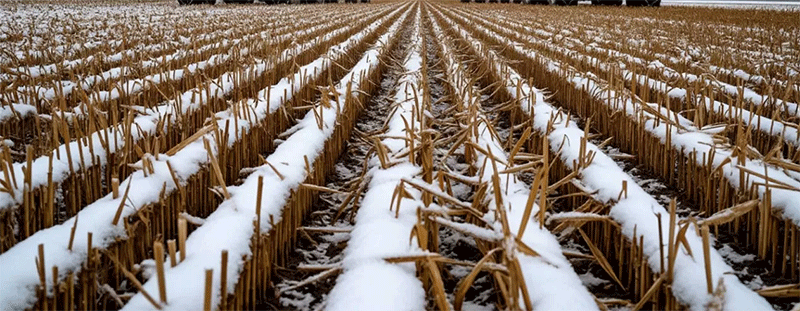
On the surface, Russia’s 2025 grain harvest appears robust. Official data indicates a total bunker weight of over 135 million tonnes, including 94 million tonnes of wheat (a 7.8% year-on-year increase) and 20.5 million tonnes of barley (up 15.4%). Average yields rose sharply by 14% for wheat and 22% for barley, with leading regions like Kurskaya and Lipetskaya oblasts reporting over 5 tonnes per hectare. However, this quantitative success story unravels under scrutiny, revealing a harvest season crippled by extreme weather and its cascading consequences. The core issue was timing and precipitation: persistent, heavy autumn rains across key regions like the Central Black Earth, South, and Western Siberia turned fields into quagmires, immobilizing machinery during the critical harvest window. This was followed by unseasonably early snow and hard frosts, trapping a significant portion of the crop—estimated at millions of tonnes—in frozen, snow-covered fields. While 133 million tonnes were officially recorded as harvested before snowfall, only 88 million tonnes of wheat reached storage, indicating massive post-harvest losses and logistical collapse.
The financial and qualitative fallout is severe. The trapped and delayed harvest led to sprouting, disease proliferation (notably fusarium and mycotoxins), and grain heating, catastrophically degrading quality. Federal monitoring data shows a mere 0.2% of the wheat crop qualified as high-grade (Classes I & II). While the proportion of the lowest quality feed wheat (Class V) slightly decreased to 22%, the share of milling wheat suitable for human consumption (Classes III & IV) remained problematic, with nearly 70% of the crop classified as low quality. In the pivotal Rostov region, a leading producer, output halved to 8.5 million tonnes with yields collapsing from 4.4 to 2.6 t/ha, and over 1.1 million tonnes were condemned due to pest infestation and quality failure. Compounding the crisis are emerging reports of potential pesticide residue non-compliance, as many producers failed to conduct mandatory lab analyses, raising food safety concerns. The financial impact on farmers is devastating, with the Rostov region alone reporting 4 billion rubles in drought-related losses, leaving many unable to service debt or finance the next season. These conditions forced regional states of emergency (ChS) in areas like Orel, Omsk, and Bashkortostan to expedite insurance and state aid claims.
The 2025 Russian grain harvest is a stark lesson in the distinction between yield and usable, marketable production. High initial yield potentials were rendered nearly moot by harvest-time weather disasters, transforming a potential record into an operational and financial catastrophe for many producers. The implications are twofold. Domestically, it underscores extreme vulnerability to climate volatility, revealing weaknesses in harvest capacity, drying infrastructure, and storage logistics for wet grain. For global markets, while volume figures remain high, the drastic reduction in high-quality milling wheat for export could tighten global supply for bread flour, even as feed grain availability increases. The season ultimately highlights that in modern agriculture, maximizing yield is insufficient without parallel investments in resilience—including flexible harvest logistics, high-capacity drying systems, and robust quality control protocols—to secure both tonnage and its economic value.
Error