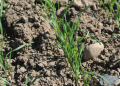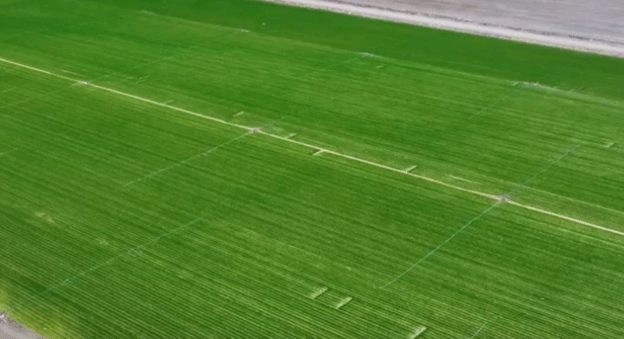
Spring has officially arrived in Changji Hui Autonomous Prefecture, a major agricultural hub in Xinjiang, and with it, 1.48 million mu (approximately 98,700 hectares) of winter wheat are entering the critical stem-elongation and tillering stage. This period determines not just plant health, but also final yield and grain quality. This year, Changji is embracing agricultural technology at full speed, mobilizing a fleet of 1,300 plant protection drones for timely chemical regulation and foliar fertilization.
In Qitai County, wheat grower Mian Xiangfen is managing a massive 7,100 mu of winter wheat. His fields are now treated with drone-sprayed leaf fertilizers and plant growth regulators (PGRs). These UAVs—pre-programmed via Beidou satellite navigation—glide over green fields, releasing fine mist across the canopy with unmatched consistency.
“Compared to manual methods, drone spraying is more uniform, avoids missed or overlapping areas, and saves both time and labor,” Mian says. “With this technology, managing our wheat fields is faster, cheaper, and more precise—this season’s yield is looking very promising.”
Each drone can:
- Carry up to 70 kg of spray material
- Cover up to 1,500 mu per day
- Generate real-time vegetation index maps via multispectral cameras
- Monitor crop health and support site-specific treatments
But drone work is only one part of Changji’s integrated agronomic strategy.
Farmer Feng Rugang in Liushuhezi Village is trialing narrowed-row planting, where traditional 7-row configurations per 4.2-meter planting width are adjusted to 6 rows with 33 cm spacing. This allows:
- More uniform seed distribution
- Reduction of one drip tape per row
- Better ventilation and light penetration
- Enhanced nutrient absorption during stem elongation and grain filling
- Reduced input costs by 10% per mu
According to Wang Yan, researcher at Qitai County Agricultural Technology Promotion Center, “We’re applying chemical regulation early to prevent excessive stem elongation and reduce lodging risks. Paired with water-fertilizer integration and chemical weeding, these combined actions are essential for improving large-scale yield performance.”
As of April 9, over 550,000 mu—37% of Changji’s winter wheat area—had already undergone first-round chemical regulation. Water and fertilizer applications are also ahead of schedule, starting nearly two weeks earlier than in previous years, in response to rising spring temperatures and rapid plant development.
Changji is now a national commodity grain base, and its transformation reflects the broader trend of agricultural modernization in China. The region has:
- Promoted high-standard farmland construction
- Introduced high-yield wheat varieties
- Adopted Beidou-guided machinery and drone fleets
- Created region-specific, science-based management protocols for each growth stage
According to China’s Ministry of Agriculture and Rural Affairs, the use of UAVs in agriculture nationwide has increased by more than 35% in 2024 alone, with drone fleets now handling over 30 million hectares annually. Xinjiang is emerging as one of the leading provinces for drone-driven crop care and high-tech wheat production.
Changji Prefecture’s successful deployment of over 1,300 drones and adaptive agronomic practices is proving that technology, when guided by science and scale, can make wheat farming more efficient, productive, and resilient. With proactive strategies like early chemical regulation, intelligent irrigation, and modern sowing techniques, Changji is setting a high standard for sustainable, high-yield cereal production in arid regions.
Error