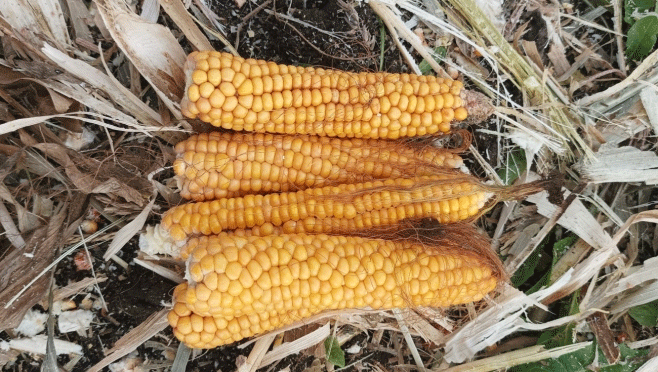
The recent completion of the harvest season in the Kuzhenersky district marks a significant agricultural milestone: for the first time in the district’s history, corn was harvested for grain. While the initial scale was modest—115 tonnes threshed from 34 hectares—the successful cultivation of this crop represents a strategic step towards agricultural diversification and climate adaptation in the region.
This pioneering trial yielded approximately 3.38 tonnes per hectare (or 33.8 centners per hectare). To contextualize this figure, it is essential to compare it with established production areas. According to the USDA’s 2024 estimates, the average corn yield in the United States is projected to be over 11.5 tonnes per hectare, while in the European Union, it hovers around 7.5 tonnes per hectare. While Kuzhenersky’s yield is lower, it is a commendable and economically relevant result for a first attempt in a non-traditional region, demonstrating the potential viability of the crop.
The broader harvest in the district further underscores a year of significant productivity. Despite challenging conditions, including lodged grain crops that complicated harvesting, a record 36.1 thousand tonnes of grain were threshed with an average yield of 2.6 tonnes per hectare (26 centners/ha). Furthermore, the district exceeded its forage targets, securing 39,908 tonnes of silage (139% of the plan), a critical output for supporting local livestock operations.
The Strategic Rationale for Corn Diversification
The decision to trial grain corn is likely driven by several compelling factors:
- Climate Adaptation: As growing seasons become longer and warmer due to climate change, regions previously considered marginal for heat-loving crops like corn are gaining new potential. This expansion is a form of climate adaptation, allowing farmers to capitalize on new agro-climatic conditions.
- Forage and Grain Security: High-yielding corn silage is a cornerstone of efficient dairy and beef production. Establishing local grain corn production can reduce reliance on imported feed, improving regional food security and insulating farmers from global price volatility and supply chain disruptions.
- Crop Rotation Benefits: Introducing corn into a rotation dominated by small grains like wheat and barley can help break pest and disease cycles, improve soil structure, and enhance overall farm resilience.
The ongoing autumn tillage (зяблевая вспашка) mentioned in the report is a critical next step, helping to incorporate crop residues, manage moisture, and prepare a optimal seedbed for the following season, whether for a repeat corn crop or another rotation member.
The successful, albeit small-scale, harvest of grain corn in the Kuzhenersky district is more than a local news item; it is a signal of a shifting agricultural landscape. It highlights a proactive approach to diversification and risk management in the face of climatic and economic pressures. While yields will need to improve through optimized hybrid selection, precision planting, and tailored nutrient management to compete with global averages, this first step proves the concept. For farmers, agronomists, and policymakers in similar regions, Kuzhenersky’s experience offers a valuable case study: the future of regional agriculture may depend on the strategic introduction of new crops that leverage changing conditions to build a more robust and self-sufficient food system.
Error