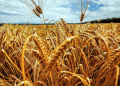
As the 2025 harvest season progresses across the Northern Hemisphere, key agricultural regions are demonstrating the results of a year’s worth of planning and execution. Penza Oblast, a major grain producer in the Volga region of Russia, is reporting outstanding results. Governor Oleg Melnichenko announced that the region has successfully harvested 2 million tonnes of grain from 500,000 hectares, achieving 60% of its planned harvest area. This milestone underscores a highly efficient and productive campaign.
The most telling metric from the governor’s report is the average yield of 42.2 centners per hectare (4.22 tonnes per hectare). This figure is notably strong, positioning Penza significantly above the projected national average for Russia. For context, the USDA’s latest estimates for Russian grain yields often hover between 2.7 and 3.2 t/ha, while the IKAR agricultural consultancy has previously reported that yields in the more productive central regions can range from 3.5 to 4.5 t/ha in a good year. Penza’s performance of 4.22 t/ha places it firmly in the upper echelon of productive regions for the season, a testament to effective agronomic management and favorable growing conditions.
Based on the current yield data and harvested area, the official forecast for the total grain harvest has been set at at least 2.7 million tonnes, with some estimates aiming closer to 3 million. This strong grain output is complemented by the start of the sugar beet harvest, with a production target of 2.5 million tonnes for this valuable industrial crop. The simultaneous success in both cereals and a root crop indicates a well-diversified and resilient agricultural sector within the oblast.
The harvest data from Penza Oblast paints a picture of a highly successful and efficient agricultural season. Achieving a yield of 4.22 t/ha on a large scale is a significant accomplishment that speaks to the adoption of modern farming practices, quality seed selection, and precise resource management. The combination of a strong grain harvest and a robust sugar beet target ensures economic stability for the region’s farms and contributes substantially to both national food security and the industrial sugar supply chain. For agronomists and farmers elsewhere, Penza’s results serve as a compelling benchmark for what is achievable with sound planning and execution in a favorable season.
Error