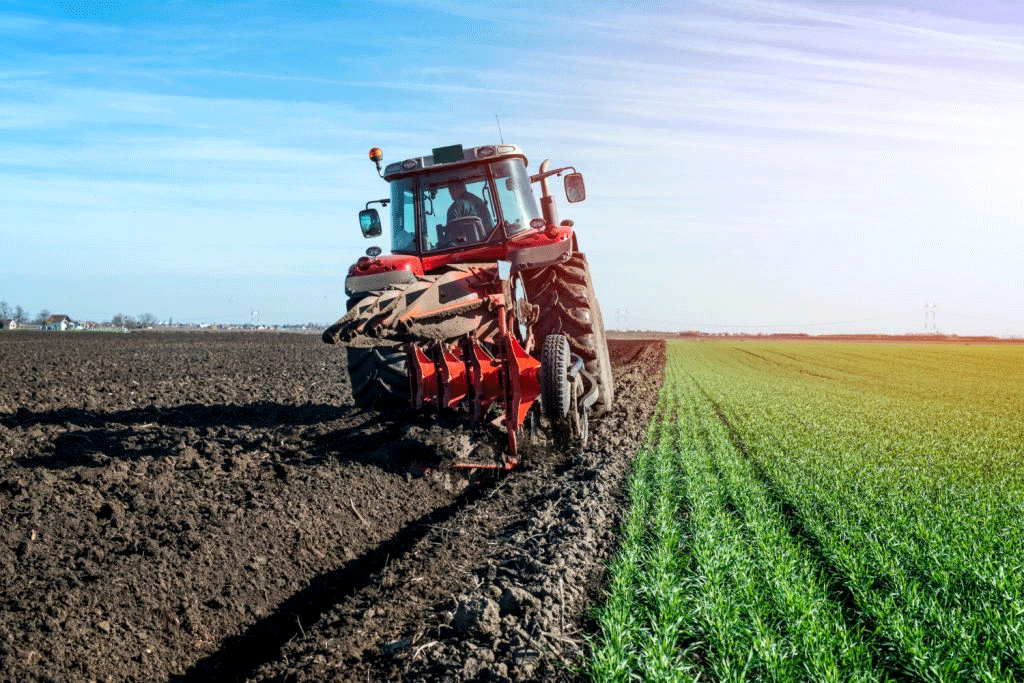
Agricultural operations in Moscow Oblast are showcasing significant progress on two critical fronts: the completion of a successful 2024 harvest and the advanced sowing campaign for the 2026 winter crop season. The region has already harvested 336,100 tonnes of winter grain, representing a substantial increase of 58,900 tonnes compared to the previous year. This impressive result is largely driven by winter wheat, which accounts for 326,900 tonnes of the total, achieving an average yield of 42.6 centners per hectare. This marks a notable 21% rise in overall regional productivity, with average yields climbing from 35.1 to 42.5 centners per hectare. This growth aligns with a broader, technology-driven trend in Russian agriculture. According to a 2024 report from the Russian Ministry of Agriculture, investments in precision farming, improved seed varieties, and optimized fertilizer use are steadily raising yield ceilings in key regions surrounding major consumption centers like Moscow.
Concurrently, the sowing campaign for the 2026 harvest is nearing completion, with 91% of the target area already planted. The crop structure reveals a strategic focus, dominated by winter wheat (73,510 hectares), followed by winter rye (over 2,400 hectares), triticale (727 hectares), and winter barley (190 hectares). This prioritization of high-yield winter wheat reflects a calculated approach to maximize production on limited land resources near a massive urban market. Furthermore, the region reports that 79,300 hectares of winter wheat, rye, and triticale are already fully prepared for winter, indicating efficient post-sowing management. This focus on regional self-sufficiency in grain production is part of a larger federal strategy. Data from the Russian Federal State Statistics Service (Rosstat) indicates that domestic grain production has been prioritized to ensure food security, with the Central Federal District, which includes Moscow Oblast, playing a crucial role in supplying the densely populated capital region.
The agricultural performance in Moscow Oblast illustrates a successful case of intensifying production in a region with significant urban pressure. The substantial yield increase and the efficient, well-planned sowing campaign for future harvests highlight a mature and strategic agricultural sector. The data confirms that through the adoption of modern agronomic practices and a focused crop rotation, regions can significantly boost productivity without necessarily expanding land use. For farmers and agricultural professionals, Moscow’s example demonstrates that targeted investments in technology and crop management can yield impressive returns, even in regions not traditionally considered the heart of the grain belt, ensuring stable food supplies for major urban centers.
Error