

Microbial inoculants have gained increasing attention worldwide as an eco-friendly solution for improving agriculture productivity. Several studies have demonstrated their potential benefits, such as enhanced resistance to drought, salinity, and pathogens. However, the beneficial impacts of inoculants remain inconsistent. This variability is attributed to limited knowledge of the mechanisms by which microbial inoculants affect crop growth and a lack of ecological characteristics of these inoculants that limit our ability to predict their beneficial effects. The first important step is believed to be the evaluation of the inoculant’s ability to colonize new habitats (soils and plant roots), which could provide crops with beneficial functions and improve the consistency and efficiency of the inoculants.
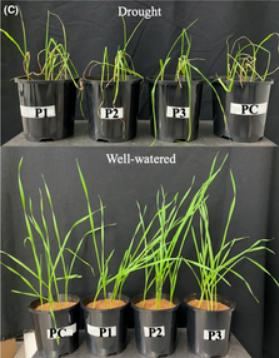
Researchers investigated the impact of three microbial inoculants (two bacterial: P1 and P2, and one fungal: P3) on the growth and stress responses of three wheat varieties in two different soil types under drought conditions. Each of these products is a bacterial consortium comprising two distinct strains of Bacillus species, namely Bacillus paralicheniforms and Bacillus subtilis. Microbial inoculant P1 consists of Bacillus paralicheniforms (strain A) and Bacillus subtilis (strain X), while microbial inoculant P2 comprises Bacillus paralicheniforms (strain B) and Bacillus subtilis (strain Y).
The impact of microbial inoculants on soil microbial communities was investigated. Plant biomass and traits were measured, and high-throughput sequencing was used to characterize bulk and rhizosphere soil microbiomes after exposure to drought stress. Under drought conditions, plant shoot weight significantly increased (11.37%) under P1 treatments compared to uninoculated controls. In addition, total nitrogen enzyme activity increased significantly under P1 in sandy soil but not in clay soil. Importantly, network analyses revealed that P1, consisting of Bacillus paralicheniformis and Bacillus subtilis, emerged as the keystone taxa in sandy soil. Conversely, P2 and P3 failed to establish as keystone taxa, which may explain their insignificant impact on wheat performance under drought conditions. In conclusion, study emphasizes the importance of effective colonization by microbial inoculants in promoting crop growth under drought conditions. Findings of the research support the development of microbial inoculants that robustly colonize plant roots for improved agricultural productivity.
Source: Li, J., Wang, J., Liu, H., Macdonald, C.A. & Singh, B.K. (2023) Microbial inoculants with higher capacity to colonize soils improved wheat drought tolerance. Microbial Biotechnology, 16, 2131–2144. Available from: https://doi.org/10.1111/1751-7915.14350
Error


