

Nematodes are among the most widespread organisms on Earth. They are capable of colonizing any ecosystem, including extreme environments, such as deserts, hot spring waters, arctic lands and polar seas. Many species of nematode are free-living, but some nematodes have developed the ability to parasitize other organisms. The evolution of plant parasitism in nematodes has occurred independently on several occasions, giving rise to at least four different groups of plant-feeding nematodes, which include over 4100 species. Plant-parasitic nematodes (PPNs) are responsible for more than $US80 billion losses in worldwide agriculture annually . The most economically important species are the sedentary endoparasitic nematodes, including the root-knot nematodes (RKNs) and the cyst nematodes of the genera Meloidogyne and Heterodera/Globodera, respectively. At least 20% of the total estimated economic losses inflicted by nematodes derive from rice alone. In rice, the environmental conditions and type of agrosystem determine the community of nematodes present and, consequently, the species profile of parasitic nematodes can differ from region to region. Many nematode species have been described in association with rice, but only a few of these have significant detrimental effects . Meloidogyne graminicola (Mg), commonly named as the rice RKN, is one of the most prevalent PPNs in rice agrosystems. It is considered to be a major threat to rice agriculture, particularly in Asia, where changes in agricultural practices in response to environmental (climate change) and socioeconomic conditions have led to a dramatic increase in Mg populations. Asia is the main rice-growing region of the world, responsible for about 90% of global rice production, which is estimated at around 740 million tons of paddy rice annually. In addition, rice is the staple food for more than 50% of the population in Asia, a figure that can reach up to 70% for southern regions of this continent. Rice production in Asia is therefore of essential importance for both local and global food security and its production is threatened by the increasing prevalence of Mg.
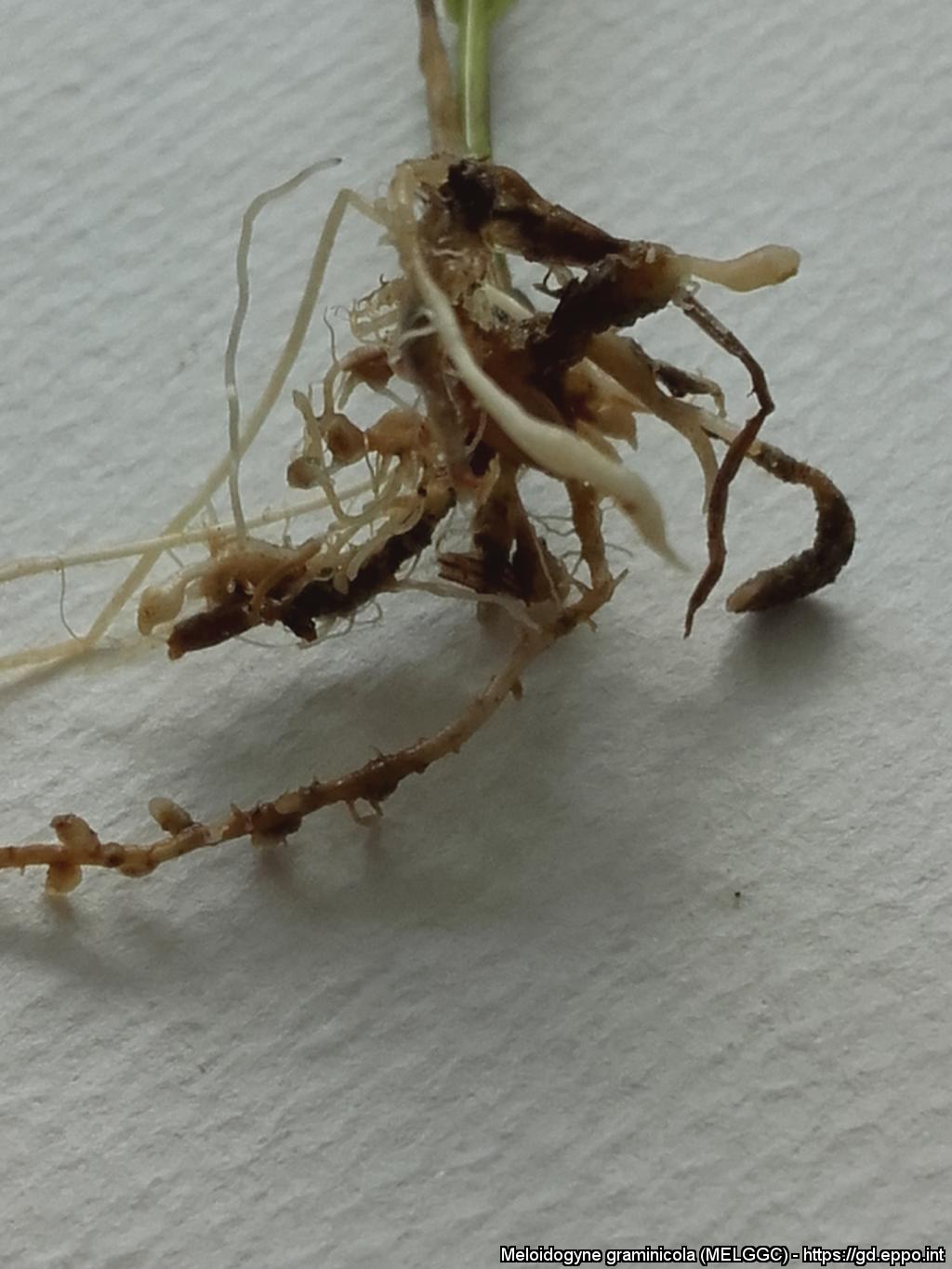
Meloidogyne graminicola is an obligate sedentary endoparasite adapted to flooded conditions. It is found in both upland (rainfed) and lowland (irrigated) rice, as well as in deepwater ecosystems, where Mg is one of the three predominant pathogenic nematode species. Infection by Mg in rice induces the formation of galls, mainly at the root tips with a characteristic hook shape, that strongly impair root development and physiology. The disruption of water and nutrient transport by the alteration of the root vascular system leads to above-ground symptoms, such as stunting, chlorosis and loss of vigour, which ultimately result in poor growth of the crop and substantial yield losses that can represent up to 87% of production . Losses in flooded rice fields occur by drowning when infected seedlings fail to elongate above the rising flood water, leaving patches of open water in flooded fields . Under simulated upland or intermittently flooded conditions, yield losses caused by Mg range from 20% to 80% and 11% to 73%, respectively . In the field, these losses may be exacerbated in combination with other biotic or abiotic stresses, such as drought. Mg is thus a severe constraint to productivity in rice-growing countries and is likely to be an underestimated pathogen because of the lack of specific above-ground symptoms that can lead growers to wrongly attribute the damage to nutritional and water-associated disorders or to secondary diseases.
Photo: EPPO (2024) EPPO Global Database. https://gd.eppo.int
Reference: Mantelin, S., Bellafiore, S. and Kyndt, T. (2017), Meloidogyne graminicola: a major threat to rice agriculture. Molecular Plant Pathology, 18: 3-15. https://doi.org/10.1111/mpp.12394
Error


