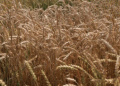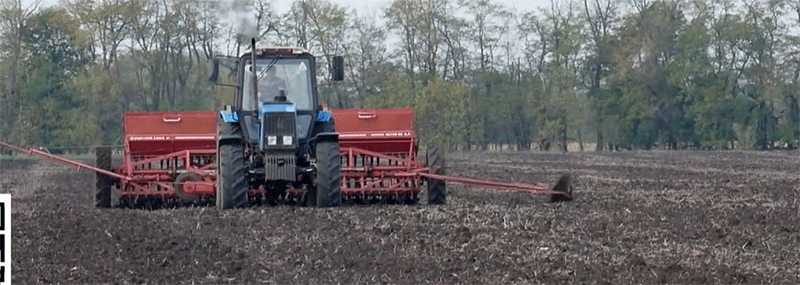
The ongoing autumn sowing campaign in Krasnodar Krai (Kuban) reveals both the scale and vulnerability of Russian grain production. Despite a two-week delay caused initially by drought and subsequently by poor weather, regional authorities report over 1 million hectares already sown with winter crops, progressing toward a target of 1.6 million hectares dedicated solely to winter wheat for the 2026 harvest. This substantial area underscores Kuban’s dominance within the Russian grain belt; the region typically contributes 20-25% of the national wheat harvest, according to the Russian Ministry of Agriculture. The sowing breakdown further includes winter barley (over 170,000 hectares) and triticale (over 2,000 hectares), confirming a focused strategy on high-yield winter cereals. However, the delayed start to the sowing window, as noted by Nikolay Grechany, Director of the Labinsk Agrarian Technical College, forced some farmers to sow into suboptimal periods like February and December in previous years, significantly compromising yield potential when the crop could not properly undergo vernalization.
The climatic challenges faced in Kuban are not isolated. They reflect a broader pattern of increasing volatility affecting major grain-producing regions. A 2024 report from the UN’s Food and Agriculture Organization (FAO) on climate change and grain production emphasizes that shifting precipitation patterns and increased frequency of extreme weather events are directly impacting sowing schedules and yield stability. The experience in Kuban, where farmers waited nearly two weeks for adequate soil moisture, is a case study in this new reality. This volatility creates significant economic risk, not just for individual farms but for global wheat markets, given Russia’s status as the world’s top wheat exporter. The reliance on such a concentrated production region highlights a systemic risk, where a single poor season in Kuban can have reverberations across international supply chains. The practical training of students like David Dzholya, who emphasizes meticulous machinery maintenance, points to the growing need for precision and adaptability in field operations to mitigate these environmental pressures.
The planned 1.6 million-hectare wheat sowing in Krasnodar Krai is a powerful statement of Russia’s continued agricultural ambition. However, the delayed and challenging 2024 sowing campaign serves as a critical warning. The region’s pivotal role in global wheat supplies is increasingly balanced on a knife’s edge of climatic uncertainty. For agronomists and farm owners, this underscores the non-negotiable need for adaptive strategies, including investment in drought-resistant varieties, improved water management, and flexible sowing protocols. The future of Kuban’s—and by extension, a significant portion of the world’s—wheat supply will depend not just on the scale of planting, but on the ability to navigate an increasingly unpredictable growing environment.
Error