

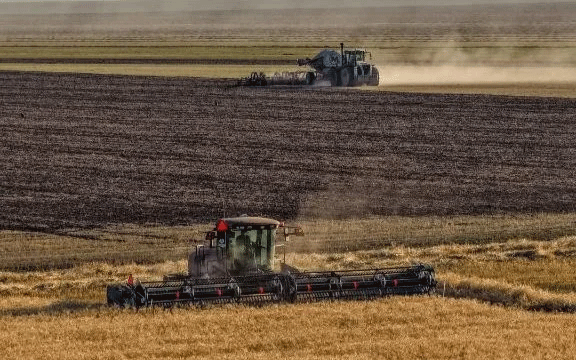
For global agricultural professionals, the progress of a harvest in a major grain-exporting nation like Kazakhstan is a critical indicator of regional supply and broader market trends. Current data from Kazakhstan’s Ministry of Agriculture reveals a harvest campaign that is both extensive and impressively productive, underscoring the country’s growing role in global food security.
As of the latest report, combines have rolled across 4.2 million hectares of Kazakhstan’s grain fields, representing 26% of the total sown area. From this portion, farmers have already threshed a substantial 5.9 million tons of grain. This early output suggests a strong foundation for the nation’s total cereal production, which is crucial for meeting both domestic needs and export obligations. Kazakhstan is a key player in the Central Asian wheat corridor, and its production levels are closely watched by international markets.
Beyond the staple grains, the data reveals a more compelling story of agricultural diversification and remarkable efficiency in high-value sectors. The yields reported for horticultural crops are particularly striking and point to advanced agronomic practices:
- Potatoes: Harvested at a yield of 241.5 quintals per hectare (q/ha).
- Vegetables: An overall impressive yield of 286.8 q/ha.
- Melons: Production exceeding 2 million tons at a yield of 272.6 q/ha.
Delving deeper into specific vegetable crops, the numbers become even more notable and provide a benchmark for producers in similar climates:
- Cabbage: 374.8 q/ha
- Onions: 394.2 q/ha
- Carrots: 302.9 q/ha
For context, according to recent FAO analyses, average global vegetable yields can vary significantly but often sit lower than these figures, highlighting the efficiency of Kazakh production in this season. This success in horticulture is a strategic move, reducing reliance on cereals and enhancing food sovereignty.
The ministry reports that the campaign is proceeding “in an organized manner and within optimal agrotechnical timeframes.” This logistical efficiency is as critical as the high yields themselves. Timely harvesting preserves crop quality, minimizes field losses, and allows for immediate follow-up operations like stubble management and soil preparation for subsequent sowings, thereby protecting the resource base for future seasons.
The mid-harvest snapshot from Kazakhstan offers several key takeaways for the global agricultural community:
- Strong Cereal Foundation: The early grain output indicates a robust harvest, reinforcing Kazakhstan’s status as a reliable grain exporter.
- Diversification and Value Addition: The exceptional yields in potatoes, vegetables, and melons are a clear indicator of successful agricultural diversification. This shift towards high-value, nutrient-dense crops enhances farm profitability and strengthens domestic food security.
- Operational Excellence: The emphasis on completing the harvest within optimal agrotechnical windows is a best practice that directly translates to preserved yield, maintained quality, and long-term soil health.
Kazakhstan’s 2024 harvest thus illustrates a dual trajectory: maintaining strength in traditional grain production while simultaneously advancing and achieving excellence in horticulture, a model of balanced agricultural development.
Error