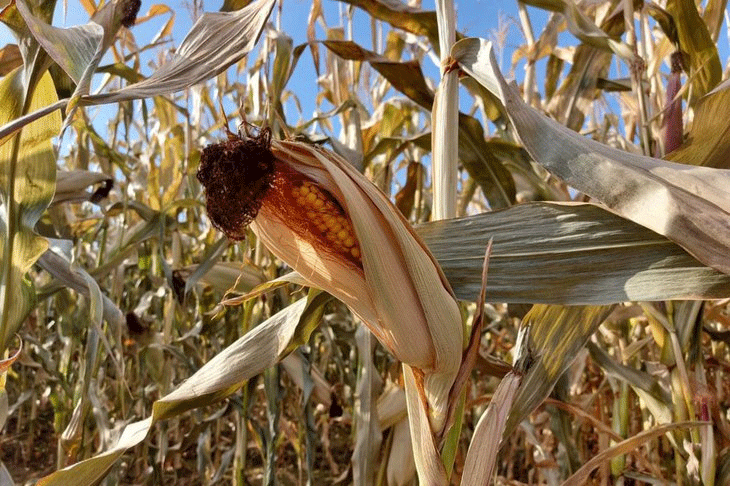
Agricultural producers and scientists in Siberia are witnessing a notable shift in the region’s production capabilities. According to the regional government of Irkutsk Oblast, the 2025 corn harvest is projected to reach 233,000 tons. This figure represents a substantial 20% increase over the previous year’s output, signaling a concerted and strategic push to bolster the local fodder base for a resilient livestock sector.
This growth is primarily attributed to a significant expansion in planted area. Farmers have allocated 10,500 hectares to corn cultivation for the 2025 season, which is 1,600 hectares more than in 2024—an increase of approximately 18%. This expansion underscores a growing confidence in corn’s viability in the Siberian climate, likely fueled by the adoption of earlier-maturing, cold-tolerant hybrids and improved agronomic practices.
The cultivation is heavily concentrated, with 74% of the total planted area located in just two districts: Cheremkhovsky and Usolsky. This concentration suggests these areas possess optimal soil conditions, infrastructure, or have leading farm enterprises driving the adoption. Production is also reported across eight other districts, including Bokhansky, Zalairnsky, Ziminsky, and others, indicating a wider regional trial and acceptance of corn as a core fodder crop.
Beyond the Headlines: The National and Global Context
While impressive for the region, it is important to contextualize these numbers within the broader agricultural landscape. According to the Russian Federal State Statistics Service (Rosstat), the total corn harvest for grain across the entire Russian Federation in 2023 was over 15.5 million tons. Irkutsk’s projected 233,000 tons, while critical for its local economy, represents a small fraction of national production.
Globally, the USDA Foreign Agricultural Service forecasts Russian corn exports for the 2024/2025 season to remain robust at 5.5 million tons, making it the world’s fourth-largest exporter. The primary focus of Irkutsk’s production, however, is not export but internal food security. The government’s report explicitly states that the crop is “necessary for ensuring the fodder base for animal husbandry.” This aligns with a national strategy of reducing dependency on imported fodder and increasing the self-sufficiency of regional livestock operations, a trend seen across many Russian regions.
The projected 20% increase in corn harvest in Irkutsk Oblast for 2025 is a strong positive indicator for the region’s agricultural sector. It reflects successful agronomic planning, likely involving better hybrid selection and land management, aimed directly at strengthening the sustainability and profitability of local livestock farming. This strategic focus on enhancing domestic fodder production is a microcosm of larger trends in Russian agriculture, emphasizing internal supply chain resilience and import substitution. For agronomists and farm owners in Siberia, these figures represent not just a good harvest, but a step forward in the region’s agricultural modernization and economic stability.
Error