For farmers and agronomists looking to diversify rotations and tap into niche markets, hybrid rye is generating renewed interest. Researchers Laura Lindsey and Matthew Hankinson from The Ohio State University have been conducting rigorous field trials over the past five years to provide data-driven recommendations for integrating this resilient cereal into farming systems, particularly in the Midwest.
Yield Performance: How Hybrid Rye Stacks Up
A primary question for any new crop is its yield potential relative to established staples. In a three-year comparison conducted in Ohio, where soft red winter wheat dominates approximately 500,000 acres annually, hybrid rye demonstrated competitive performance.
- Soft Red Winter Wheat: Achieved the highest average yield at 90 bushels per acre.
- Hybrid Rye: Showed strong potential with an average yield of nearly 80 bushels per acre.
- Open-Pollinated Rye: Averaged 70 bushels per acre.
This data positions hybrid rye as a viable, high-yielding alternative, capable of producing roughly 89% of the yield of a standard wheat crop under the same conditions.
Optimizing Agronomics: Planting Date and Seeding Rate
Multi-state research across Kentucky, Ohio, Wisconsin, and Minnesota during the 2021-2022 and 2022-2023 growing seasons focused on key agronomic levers. In Ohio, results were particularly promising, with grain yields averaging a robust 90 bu/acre across various planting dates and seeding rates. The research pinpointed the optimal window: planting within two weeks after the Hessian fly-free date. Furthermore, a seeding rate of at least 800,000 seeds per acre was critical for maximizing yield potential, ensuring adequate stand establishment and competition.
Nitrogen Management: Finding the Economic Sweet Spot
A critical 2024-2025 study investigated the spring nitrogen response of three hybrid rye varieties. First-year results revealed important location-specific nuances:
- Clark County: The optimal N rate for yield was approximately 80 pounds per acre.
- Wood County: A higher rate of 120 pounds per acre was required to maximize yield.
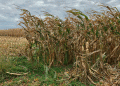
The researchers crucially note that the rate for maximum yield may not equate to maximum economic return, emphasizing the need for farm-specific cost-benefit analysis. No interaction was found between the hybrid variety and the N rate, simplifying recommendations. However, a significant observation was increased lodging (up to 70% of plants) at the Clark County site, which was correlated with higher nitrogen application rates.
The body of work from Ohio State University makes a compelling case for hybrid rye as a credible and productive rotational crop. While it may not consistently out-yield soft red winter wheat, its near-parity performance, combined with its known benefits for soil structure and weed suppression, offers a valuable tool for diversified farming operations. The key to success lies in precise management: adhering to a timely planting schedule post-Hessian fly date, using a sufficient seeding rate, and implementing a localized, conservative nitrogen strategy that balances yield goals with the risks of lodging. As research continues into the 2025-2026 season, these data-driven guidelines provide a solid foundation for farmers to begin evaluating hybrid rye’s fit on their operations.
Error