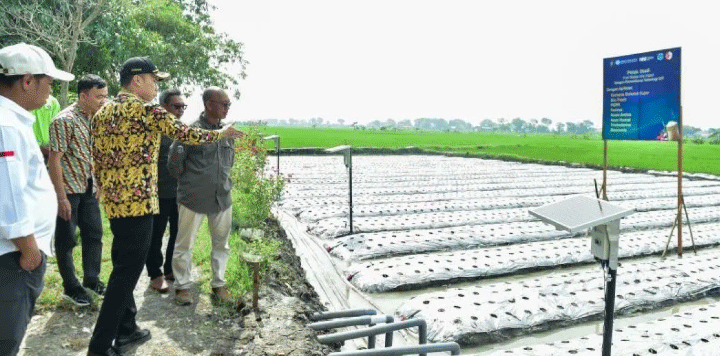
Farmers in Miru Village, Sekaran District, Lamongan Regency, East Java, have set an impressive benchmark by increasing their healthy rice productivity to 10 tons per hectare, up from the previous 7 tons. This achievement was made possible through a comprehensive support program led by Bank Indonesia (BI) in collaboration with local farming groups, academic institutions, and government agencies.
Key Drivers of Success
- Technology & Innovation
- Adoption of digital farming techniques and drip irrigation systems optimized water and nutrient use, reducing production costs while increasing yields.
- According to the Food and Agriculture Organization (FAO, 2024), precision agriculture methods can improve rice yields by 20-30% while conserving resources.
- Institutional Strengthening & Market Adaptation
- BI’s program focused not only on financing but also on farmer education, cooperative development, and market-responsive strategies.
- A 2024 World Bank report highlights that farmer collectives with strong institutional support see 15-25% higher profitability due to better bargaining power and reduced input costs.
- Cross-Sector Collaboration (Pentahelix Model)
- The partnership involved local government, Bank Indonesia, Universitas Brawijaya, farmers’ groups, and media, ensuring holistic support.
- Similar models in Vietnam and Thailand have shown that public-private-academic collaborations can sustainably boost agricultural output by 12-18% annually (IRRI, 2023).
Economic & Environmental Benefits
- Reduced production costs and higher selling prices for healthy rice improved farmers’ incomes.
- Drip irrigation minimized water wastage, aligning with global climate-smart agriculture (CSA) goals (FAO, 2025).
A Replicable Model for Sustainable Agriculture
Lamongan’s success demonstrates that integrated support systems—combining technology, financing, education, and policy—can transform smallholder farming. As global food demand rises, such models should be scaled up, leveraging AI-driven agronomy, renewable energy-powered farms, and blockchain-based supply chains for transparency.
Error