
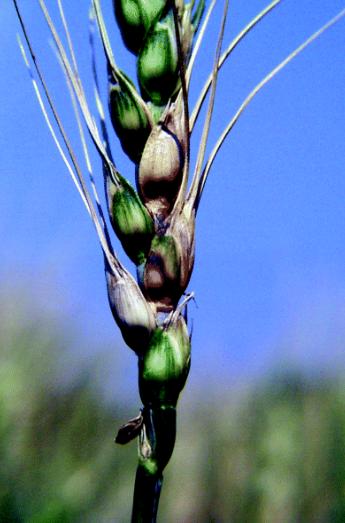
The fungal pathogen Fusarium graminearum Schwabe [teleomorph Gibberella zeae], is the most common causal agent of Fusarium head blight (FHB) across the world. This destructive disease, commonly but perhaps inappropriately known as scab, affects wheat, barley and other small grains both in temperate and in semitropical areas. The disease has the capacity to destroy a potentially high-yielding crop within a few weeks of harvest.
The threat posed by this fungus is multifaceted. It causes yield and quality losses due to sterility of the florets and formation of discoloured, withered and light test-weight kernels. These characteristics cause difficulties for marketing, exporting and processing infected grain. Additionally, infected grains may contain significant levels of trichothecenes and the oestrogenic mycotoxin, zearelanone, which are hazardous to animals, thus making the grain unfit for food or feed. Trichothecene toxins such as deoxynivalenol (DON), commonly known as vomitoxin, are sesquiterpenoids that are potent inhibitors of eukaryotic protein biosynthesis. Acute adverse effects of the toxin in animals include food refusal, diarrhoea, emesis, alimentary haemorrhaging and contact dermatitis. In humans, F. graminearum has been linked to alimentary toxic aleukia and Akakabi toxicosis, illnesses characterized by nausea, vomiting, anorexia and convulsions. Perhaps as expected for inhibitors of protein synthesis, chronic exposure to trichothecenes has wide-ranging effects, including neurological disorders and immunosuppression. Plant cultivars highly resistant to the disease or tolerant to the toxin currently are not available and the use of fungicides for controlling the disease is limited by cost, difficulty in efficient application to wheat heads and an incomplete understanding of factors that influence disease development.
Primary inoculum for this disease comes from infected plant debris on which the fungus overwinters as saprophytic mycelia. In spring, warm moist weather conditions are favourable for the development and maturation of conidia and perithecia that produce ascospores concurrently with the flowering of cereal crops. The sticky ascospores are forcibly discharged from mature perithecia formed on the surface of crop debris (e.g. corn stubble) and dispersed by wind, rain or insects to host plants.
Reference: GOSWAMI, R.S. and KISTLER, H.C. (2004), Heading for disaster: Fusarium graminearum on cereal crops. Molecular Plant Pathology, 5: 515-525. https://doi.org/10.1111/j.1364-3703.2004.00252.x
Error