
• About
  • Advertise
  • Careers
  • Contact
Saturday, December 13, 2025
  • Login
No Result
View All Result
Field Crops news
  • Home
  • News
  • AgroTech & Innovation
  • Science
  • Sustainability
  • Market News
  • Research & Development
  • Home
  • News
  • AgroTech & Innovation
  • Science
  • Sustainability
  • Market News
  • Research & Development
No Result
View All Result
Field Crops news
No Result
View All Result
Home News

From Corporate to Crops: How Organic Farming is Boosting Profits and Sustainability in Punjab

by Tatiana Ivanova
14 July 2025
in News, Organic
0
From Corporate to Crops: How Organic Farming is Boosting Profits and Sustainability in Punjab
0
SHARES
3
VIEWS
Share on FacebookShare on Twitter

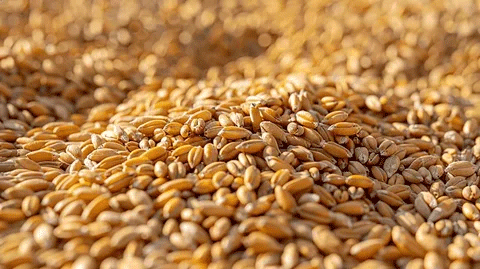
Sucha Singh Pabla, a former corporate manager in Abu Dhabi, has proven that organic farming can be both environmentally sustainable and highly profitable. At 70, Pabla manages 32 acres in Sherpur Bet, Punjab, where he cultivates organic wheat, vegetables, and paddy—earning ₹7 lakh from 200 quintals of wheat alone this year. His secret? Avoiding chemical inputs entirely, relying instead on vermicompost and natural farming techniques.

Higher Prices, Lower Costs: The Economics of Organic Wheat

While conventional wheat farming in Punjab yields 20-22 quintals per acre, Pabla’s organic fields produce 14-15 quintals. However, his wheat sells at ₹3,500 per quintal—far above the standard ₹2,425—attracting buyers from Punjab, Himachal Pradesh, and Haryana. According to a 2023 report by the Indian Council of Agricultural Research (ICAR), organic wheat commands a 20-30% price premium in domestic markets due to rising health consciousness. Additionally, Pabla’s input costs are minimal, as he produces his own vermicompost and avoids synthetic fertilizers.

Beyond Wheat: Diversification and Sustainable Practices

After the wheat season, Pabla grows organic vegetables and cultivates paddy on a separate 4-acre plot. Crucially, he avoids stubble burning—a major contributor to air pollution in North India. Instead, he reintegrates crop residue into the soil, preserving microbial health. A 2024 study by Punjab Agricultural University (PAU) found that residue incorporation can increase soil organic carbon by 15% over five years, enhancing long-term fertility.

Training the Next Generation of Organic Farmers

Pabla’s journey began in 2015 after returning from Abu Dhabi, where he spent two decades in corporate life. He later trained in Israel, learning advanced techniques like polyhouse farming and vermicomposting. Today, he mentors aspiring organic farmers and collaborates with Punjab Agro Industries Corporation to promote sustainable agriculture.

A Model for the Future of Farming

Pabla’s success demonstrates that organic farming is not just an environmental choice but a lucrative business model. With premium pricing, lower input costs, and government support, transitioning to organic methods can benefit farmers economically while restoring soil health and reducing pollution. As demand for chemical-free food grows, his story offers a blueprint for sustainable agriculture in India.

Error

Tags: agro-industrycrop residueOrganic Farmingpremium pricingPunjab FarmingSoil Healthstubble burningsustainable agriculturevermicompostWheat Cultivation

Tatiana Ivanova

Next Post
Sustainable Agriculture Innovations in Inner Mongolia: Boosting Yields and Farmer Incomes

Sustainable Agriculture Innovations in Inner Mongolia: Boosting Yields and Farmer Incomes

Newsletter

The Sweet Taste of Altitude: Kaida Brand Corn Captivates Consumers

The Sweet Taste of Altitude: Kaida Brand Corn Captivates Consumers

4 September 2024

Russia’s Wheat Exports Plummet: Key Trends, Market Shifts, and What Lies Ahead

6 July 2025

Farming with AI: How One App Is Revolutionizing Wheat Production in North China

11 April 2025

Russia Rises to Third-Largest Wheat Supplier to China: A New Era in Agricultural Trade

29 September 2024

Mozambique’s Wheat Supply at Risk: Foreign Currency Shortage Threatens Food Security

8 April 2025

Tomsk Farmers Face Wheat Crop Loss Due to Heavy Rains: A Climate Challenge in Harvest Season

30 August 2024

Progressing Agricultural Innovation in Goiás: A New Project Completion

15 October 2024

Global Food Price Index Stable Despite Vegetable Oil Surge

11 July 2024

Altai Krai: Russia’s Rising Agricultural Powerhouse Leverages Leasing for Growth

13 October 2025

Market Update: Grain Prices and Weather Forecasts Impacting Global Agriculture

12 July 2024
  • About
  • Advertise
  • Careers
  • Contact
Call us: +51 93 999 5140

© 2020-2024 Field Crops news

Welcome Back!

Login to your account below

Forgotten Password?

Retrieve your password

Please enter your username or email address to reset your password.

Log In
No Result
View All Result
  • Home
  • News
  • Science
  • Sustainability
  • AgroTech & Innovation
  • Market News
  • Science
  • Research & Development
  • About
  • Contact

© 2020-2024 Field Crops news