For decades, the agricultural industry has been locked in a costly and environmentally damaging cycle: to achieve high yields, wheat—the world’s second-largest cereal crop—requires immense amounts of synthetic nitrogen fertilizer. Globally, wheat cultivation consumes approximately 18% of all nitrogen fertilizer produced, a industry that manufactured over 800 million tons in 2020 alone according to the UN FAO. However, this comes at a steep price. It is estimated that plants uptake only 30-50% of applied nitrogen; the rest leaches into waterways, creating dead zones, or is converted into nitrous oxide, a greenhouse gas nearly 300 times more potent than CO2.
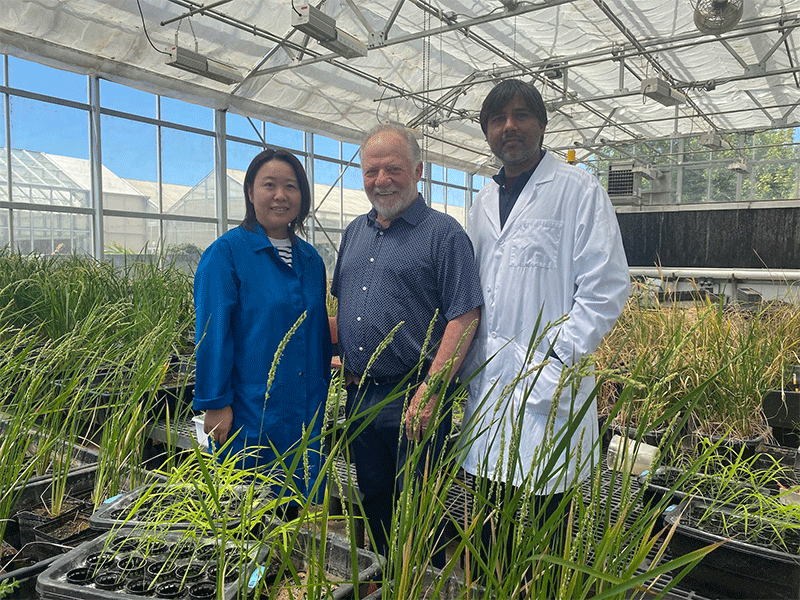
A transformative solution may now be on the horizon. A research team at the University of California, Davis, led by Distinguished Professor Eduardo Blumwald, has successfully developed wheat plants that can stimulate the soil microbiome to produce their own fertilizer. This pioneering work, published in the Plant Biotechnology Journal, represents a paradigm shift in cereal crop production and offers a path toward truly sustainable intensification.
A Novel Approach to an Age-Old Problem
Previous attempts to solve cereal crops’ nitrogen dependency focused on emulating legumes—trying to engineer root nodules to house nitrogen-fixing bacteria. These efforts largely failed. The UC Davis team took a radically different, and more pragmatic, approach. “We said the location of the nitrogen-fixing bacteria is not important, so long as the fixed nitrogen can reach the plant, and the plant can use it,” explained Blumwald.
The team screened 2,800 naturally occurring chemicals produced by plants and identified 20 that stimulate bacteria to form protective biofilms. These biofilms create the low-oxygen environment necessary for the bacterial enzyme nitrogenase to convert atmospheric nitrogen (N₂) into ammonia (NH₃), a form plants can use.
The CRISPR Key: Supercharging a Natural Process
Using the gene-editing tool CRISPR, the researchers modified wheat plants to overproduce one of these key chemicals, a flavone called apigenin. The engineered wheat releases this excess apigenin through its roots into the surrounding soil. In laboratory experiments, this apigenin signal acted as a trigger, instructing native soil bacteria to form biofilms and commence nitrogen fixation. The wheat plants were then able to successfully assimilate this naturally fixed nitrogen, demonstrating a higher yield compared to control plants when grown in nitrogen-poor conditions.
Global Implications: From Food Security to Billions in Savings
The potential implications are vast. For farmers in developed nations, the economic savings could be monumental. With U.S. farmers spending nearly $36 billion on fertilizers in 2023 (USDA data), Blumwald conservatively estimates that a 10% reduction in fertilizer use on the nearly 500 million acres of U.S. cereal crops could save over $1 billion annually.
For the developing world, the impact could be even more profound. “In Africa, people don’t use fertilizers because they don’t have money… Imagine, you are planting crops that stimulate bacteria in the soil to create the fertilizer that the crops need, naturally. Wow! That’s a big difference!” Blumwald stated. This technology could be a cornerstone for improving food security and farm profitability in low-input systems without exacerbating pollution.
The development of self-fertilizing wheat through CRISPR gene editing is a watershed moment for agricultural science. It moves beyond incremental efficiency gains and offers a systemic solution to one of farming’s greatest challenges: its dependence on synthetic nitrogen. While further field trials are needed to confirm efficacy at scale, this technology promises a future where wheat production is less costly for farmers and significantly less harmful to the planet. By harnessing the natural synergy between plants and soil bacteria, we are stepping into an era of climate-smart agriculture that is both productive and sustainable.
Error