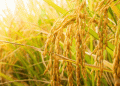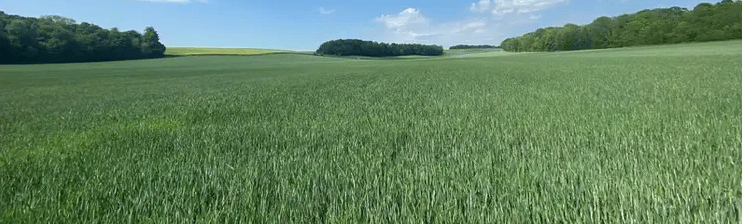
Winter crops in northern France are generally in good condition with minimal disease pressure, but the ongoing drought is threatening their potential. According to the latest reports, the northern half of France has experienced significantly drier and sunnier weather than the south since the beginning of the year. February, March, and April were dominated by anticyclonic conditions, leading to the lowest cumulative rainfall in 20 years in some regions, such as Hauts-de-France (Arvalis, 2024).
Winter Crops in Fair Condition, But Rooting Issues Persist
Visually, crops like soft wheat, winter peas, and rapeseed appear healthy. Charlotte Boutrouille, an agronomist at Arvalis, notes that wheat in Hauts-de-France is “very green” with efficient nitrogen uptake. Disease pressure remains low, with only minor cases of yellow rust in susceptible wheat varieties (Arvalis, 2024).
However, the real concern lies beneath the surface. Soil structures have deteriorated due to erratic frost-thaw cycles, heavy rains in recent years, and poor field conditions during planting. Delphine Boutte, an agronomist in Île-de-France, warns that “damaged soil structures limit root development, making crops vulnerable to climatic stress.”
Water Deficit Threatens Yield Potential
With some areas experiencing three weeks without rain, water stress is becoming critical. Constance Richard, an agronomy manager in Lorraine, highlights that “rapeseed and winter cereals were sown in degraded soils with shallow root systems.” If no significant rain arrives soon, grain filling and pod formation in rapeseed could be severely impacted.
In the Paris Basin, wheat growth has accelerated suddenly, raising concerns about yield stability. Hugh Desmet of Valfrance notes that “if dry conditions persist, grain filling will be stressed, reducing final yields—especially in late-sown fields following maize harvests.”
Spring Barley and Legumes Under Pressure
Spring barley, already struggling with drought, shows uneven growth. Early-sown barley (late February) is faring better than later plantings, which suffered from water scarcity (Arvalis, 2024). Meanwhile, spring peas, now in early flowering, urgently need rain to sustain their promising biomass (Vivescia, 2024).
Maize and Sunflower: A Promising Start
On a positive note, maize and sunflower crops have been sown in favorable conditions, benefiting from warm temperatures. However, sunflower fields face challenges due to recent temperature swings, including frosts followed by 30°C heatwaves (Vivescia, 2024).
Rain Needed to Salvage the Season
While winter crops currently appear healthy, the lack of deep rooting and worsening water deficits threaten yield stability. Farmers are hoping for steady rainfall in the coming weeks to secure even an “average” harvest. Without it, grain and oilseed yields could decline sharply, particularly in regions with already degraded soils.
Error