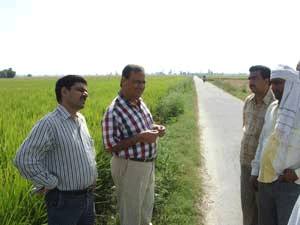
The Central Soil Salinity Research Institute (CSSRI), Karnal, has pioneered a breakthrough in rice cultivation with the development of CSR 30, a salt-tolerant Basmati rice variety. This innovation is proving to be a game-changer for farmers dealing with saline and alkaline soils, particularly in Haryana, where it now covers 60% of the Basmati cultivation area (CSSRI, 2023).
Why CSR 30 Stands Out
- Thrives in Saline & Sodic Soils: Unlike traditional Basmati varieties, CSR 30 exhibits remarkable resilience in high-salt conditions, making it ideal for degraded lands.
- Higher Yields & Profitability: Farmers report yields of 28-37 quintals per hectare, a significant improvement over older varieties (Indian Council of Agricultural Research, 2023).
- Strong Market Demand: Its premium grain quality ensures better prices in domestic and international markets, enhancing farmer incomes.
Success Stories: Farmers Leading the Change
- Shri Ishram Singh (Kachhwa, Haryana): After adopting CSR 30, his yields jumped from 13-11 quintals/acre to 15-13 quintals/acre, thanks to CSSRI’s technical support.
- Shri Vikram Singh (Expanding to Madhya Pradesh): Inspired by CSR 30’s success, he purchased 30 acres in Itarsi, achieving 37 quintals/hectare—proof of its adaptability across diverse agro-climatic zones.
Scientific & Institutional Support
Dr. S.K. Sharma (Head, Crop Improvement, CSSRI) emphasizes that CSR 30 has raised farmer incomes by 20-30% in saline regions. Collaborations with the National Seeds Corporation and state agencies ensure high-quality seed availability, further scaling production.
A Sustainable Future for Saline Agriculture
CSR 30 is more than a crop—it’s a lifeline for farmers battling soil salinity. With its high yields, market appeal, and adaptability, this variety is setting a new standard for climate-resilient agriculture. As adoption grows, CSR 30 could pave the way for reclaiming millions of hectares of unproductive land globally.
Error