• About
  • Advertise
  • Careers
  • Contact
Friday, December 5, 2025
  • Login
No Result
View All Result
Field Crops news
  • Home
  • News
  • AgroTech & Innovation
  • Science
  • Sustainability
  • Market News
  • Research & Development
  • Home
  • News
  • AgroTech & Innovation
  • Science
  • Sustainability
  • Market News
  • Research & Development
No Result
View All Result
Field Crops news
No Result
View All Result
Home Research & Development

Crop rotation for management of plant-parasitic nematodes in forage corn production

by Maria YEROKHOVA
30 July 2024
in Research & Development
0
Crop rotation for management of plant-parasitic nematodes in forage corn production
0
SHARES
5
VIEWS
Share on FacebookShare on Twitter

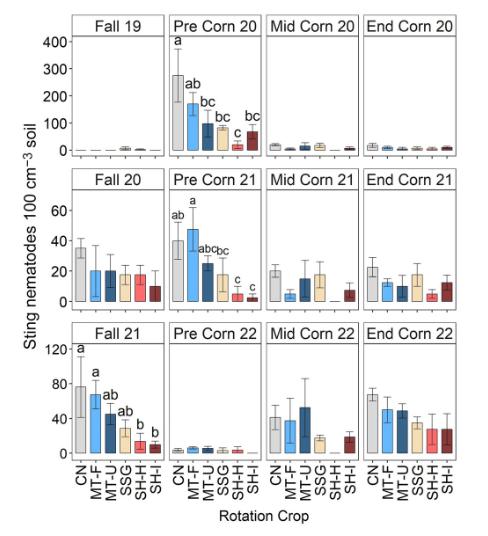
Corn (Zea mays L.) is an important silage source for dairy cattle production in the southeastern United States. Silage corn is often grown continuously, which frequently results in severe pressure from plant-parasitic nematodes such as sting nematode (Belonolaimus longicaudatus). Crop rotation is one of the few nematode management options available in forage production. The research objective was to assess summer-planted rotation crops, preceding spring silage corn, for management of plant-parasitic nematodes. Rotation crops included field corn, pearl millet [Cenchrus americanus (L.) Morrone]—with or without fertilizer—, sorghum-sudangrass [Sorghum bicolor (L.) Moench × Sorghum sudanense Piper], and sunn hemp (Crotalaria juncea L.), which was either incorporated into soil or harvested. Rotation crops were assessed in a 3-year field study in central Florida. Sunn hemp treatments significantly reduced sting nematode soil abundances relative to corn by 84%, 90%, and 84% before spring corn planting in 2019–2020 and 2020–2021 and at rotation crop termination in 2021–2022, respectively. Abundances of other plant-parasitic nematodes were not consistently influenced by rotation. Biomass of winter rye (Secale cereale L.)—a bridge cover crop between summer and spring crops—was consistently increased following sunn hemp with significant increases of 87%, 106%, and 186% relative to following corn in 2019–2020, 2020–2021, and 2021–2022, respectively. Similarly, sunn hemp significantly increased spring corn yield by 70% and 136% relative to double-cropped corn in 2020–2021 and 2021–2022, respectively. Overall, rotation with sunn hemp improved plant-parasitic nematode management in forage corn production relative to rotations with only gramineous crops.

Reference: Tsegay, M. W., Wallau, M. O., Liu, C., Dubeux, J. C., Jr., & Grabau, Z. J. (2024). Crop rotation for management of plant-parasitic nematodes in forage corn production. Agronomy Journal, 116, 313–325. https://doi.org/10.1002/agj2.21522

Error

Tags: plant-parasitic nematodesrotation

Maria YEROKHOVA

Next Post
Harvest 2024: Why Are Barley Yields Disappointingly Low? Expert Insights

Harvest 2024: Why Are Barley Yields Disappointingly Low? Expert Insights

Newsletter

Crop at Risk: How Weather Challenges Are Impacting Corn-Bean Mixtures

Crop at Risk: How Weather Challenges Are Impacting Corn-Bean Mixtures

28 November 2024

French Wheat 2025: A Tale of Two Qualities – Plummeting Protein Amidst Strong Technical Specs

8 September 2025

Navigating Russia’s Grain Harvest and Export Outlook for 2025: Challenges and Opportunities

10 March 2025

Restoring the Roots: Oneida Nation Revives Wild Rice Harvesting Traditions

16 September 2024

Snowbound Harvest: Crisis or Manageable Delay for Kazakhstan’s Wheat?

16 October 2025

Obama Wants To Visit Ubud On Low-key Bali Vacation: Bali Official

17 April 2024

Unlocking High-Yield Fodder: India’s National Seed Corp Promotes ‘Kent’ Oats for Sustainable Dairy Nutrition

9 September 2025

Only 25% of Russia’s 2024 Wheat Harvest Qualifies as Grade 3: A Sign of the Season’s Challenges

31 August 2024

Global Grain Market Update: Wheat Prices Firm While Canola Declines

6 September 2024

Pakistan Acts to Prevent Wheat Storage Losses: A Timely Intervention for Food Security

11 March 2025
  • About
  • Advertise
  • Careers
  • Contact
Call us: +51 93 999 5140

© 2020-2024 Field Crops news

Welcome Back!

Login to your account below

Forgotten Password?

Retrieve your password

Please enter your username or email address to reset your password.

Log In
No Result
View All Result
  • Home
  • News
  • Science
  • Sustainability
  • AgroTech & Innovation
  • Market News
  • Science
  • Research & Development
  • About
  • Contact

© 2020-2024 Field Crops news