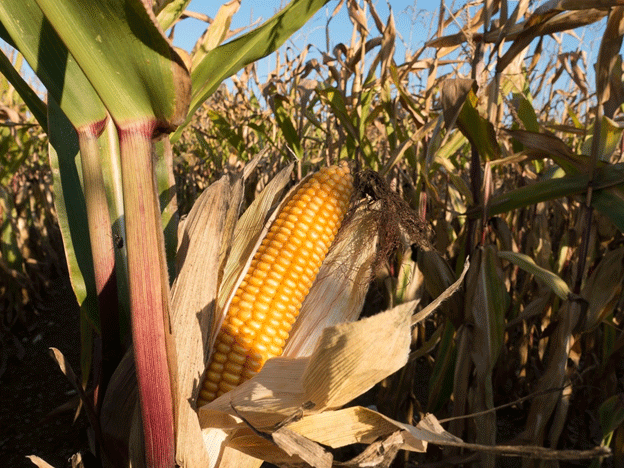
Corn yields in Russia have dropped dramatically this year, nearly halving compared to the previous season. As of September 2024, the U.S. Department of Agriculture (USDA) has downgraded its corn production forecast for Russia by 0.6 million tons to 13.5 million tons (excluding Crimea and newly incorporated regions). In addition, the USDA reduced its projection for Russia’s corn export potential by 0.4 million tons, bringing it down to 3.8 million tons—2.4 million tons lower than last season.
Similarly, the Russian Grain Union (RGU) has issued a more severe forecast. According to Arkady Zlochevsky, president of the RGU, the decrease in yield, observed during the harvest, is driving down their production and export estimates. The RGU now expects Russia’s total corn harvest to reach just over 13 million tons, with export volumes potentially falling by 2 million tons. However, Zlochevsky emphasizes that the domestic market will remain unaffected, as corn is not a critical crop for Russia. The primary impact will be felt in exports, but domestic needs for this grain will still be fully met.
Other analysts take an even more pessimistic view. Vladimir Petrichenko, CEO of ProZerno, estimates that Russia may harvest as little as 12.4 million tons of corn this season, a significant drop from last year’s record harvest of 16.2 million tons. Petrichenko highlights that the average corn yield stands at just 32.5 centners per hectare—compared to 61.1 centners per hectare during the same period last year. The harvest is still in its early stages, with only 13.3% of the total area harvested so far, but experts are warning that the overall low yields are a concerning sign.
The five-year average for corn production in Russia is around 15.2 million tons, meaning this year’s figures are well below that benchmark. Despite this, Zlochevsky remains cautious about predicting any major price hikes for corn in the near term. He expects that prices might rise in the second half of the season, not necessarily due to the reduced corn harvest but because of an overall decrease in grain yields across Russia.
With corn currently cheaper than wheat on the global market, demand for Russian corn exports remains strong. However, as grain yields, in general, are predicted to decline, prices for wheat and barley may strengthen, leading to an eventual increase in demand—and thus price—for corn within Russia.
This shift may also affect livestock farmers, who tend to be flexible in their demand for feed crops. They could potentially shift toward cheaper feed options, such as corn, if wheat and barley prices continue to climb, further increasing domestic demand for corn as the season progresses.
The sharp decline in Russian corn yields this season signals a challenging period for the country’s agricultural sector, particularly for exports. While domestic needs for corn will likely be met, export volumes are projected to drop substantially, and the potential for price increases looms as grain yields decrease overall. The situation could lead to a more competitive grain market, particularly in the second half of the season, with corn playing a key role as prices adjust to lower yields.
Error