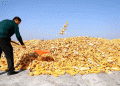
A quiet revolution is unfolding in Russian agriculture as new corn varieties developed through advanced breeding techniques are delivering unprecedented yield increases of 10-15% while dramatically improving climate resilience. These innovations, particularly from Kabardino-Balkaria, represent a significant leap forward in crop genetics that could transform Russia’s agricultural landscape and reduce dependency on imported seeds.
Breakthrough Breeding Technologies
The most remarkable aspect of these new varieties is the dramatically reduced development timeline. While traditional corn breeding required 10-15 years to develop new varieties, modern techniques have compressed this process to just a few growing seasons. Researchers have achieved this through:
- Molecular marker-assisted selection: Enabling precise trait identification and transfer
- Genetic sequencing: Allowing targeted improvement of specific characteristics
- Rapid generation advancement: Using controlled environments to accelerate breeding cycles
- Local germplasm utilization: Incorporating adapted genetic material from Russian varieties
According to the International Maize and Wheat Improvement Center, such advanced breeding techniques can reduce development time by 60-70% while improving selection accuracy by 40-50% compared to conventional methods.
Yield Performance and Economic Impact
The new hybrids demonstrate exceptional field performance:
- Yield increase: 10-15% higher yields compared to conventional varieties
- Multiple ears: 2-3 ears per plant instead of the typical single ear
- Germination rate: 95% success compared to 80-85% industry standard
- Climate resilience: Maintained performance under variable weather conditions
These improvements have significant economic implications. The Russian Ministry of Agriculture estimates that each 1% increase in corn yields generates approximately $50-70 million in additional agricultural value nationwide, making the 10-15% improvement potentially worth $500 million to $1 billion annually.
White-Seeded Hybrid Development
Particular attention is being paid to white-seeded hybrids based on local genetic resources. These varieties, currently undergoing trials in the Prokhladnensky district, offer several advantages:
- Local adaptation: Specifically bred for Russian growing conditions
- Quality characteristics: Improved nutritional profile and processing qualities
- Disease resistance: Enhanced tolerance to regional pathogens
- Yield stability: Consistent performance across varying environments
The focus on local genetic resources is particularly significant. The Food and Agriculture Organization reports that locally adapted varieties typically show 20-30% better performance than imported varieties under regional growing conditions.
Climate Resilience and Adaptation
The new varieties demonstrate exceptional tolerance to climate variability:
- Drought resistance: Maintained growth during water-limited periods
- Temperature flexibility: Performance across varying temperature regimes
- Disease tolerance: Reduced susceptibility to climate-influenced pathogens
- Yield stability: Consistent production despite weather fluctuations
This climate resilience is increasingly valuable as weather patterns become more variable. The Global Crop Diversity Trust estimates that climate-adapted varieties can reduce yield losses by 20-40% during adverse growing seasons.
Import Substitution and Food Security
The development of competitive domestic varieties supports Russia’s strategic food security objectives:
- Reduced import dependence: Decreasing reliance on foreign seed companies
- Technology sovereignty: Building domestic expertise in advanced breeding
- Cost reduction: Lower seed costs for farmers compared to imported alternatives
- Adaptation advantage: Varieties specifically bred for local conditions
The Russian National Seed Association reports that domestic seed production has increased by 35% over the past five years, reducing import dependence from 45% to 30% for major agricultural crops.
DNA Collection and Future Development
Researchers are building comprehensive DNA collections to support future breeding efforts. This genetic repository will enable:
- Rapid trait identification: Quick identification of valuable genetic characteristics
- Precision breeding: Targeted development of varieties with specific traits
- Climate adaptation: Development of varieties for future climate scenarios
- Quality improvement: Enhancement of nutritional and processing characteristics
Global Context and Competitiveness
Russia’s advances in corn breeding mirror global trends in agricultural innovation:
- United States: Drought-tolerant varieties now cover 80% of corn acreage
- China: Molecular breeding has reduced development time by 60%
- Brazil: Heat-resistant hybrids have increased yields by 25%
- European Union: Focus on local adaptation and sustainability
The World Bank reports that countries investing in agricultural research typically achieve 3-5% annual productivity growth, compared to 1-2% for those relying on imported technology.
Implementation Challenges and Solutions
Several challenges remain for widespread adoption:
- Seed production scaling: Meeting demand for quality seeds
- Farmer education: Demonstrating benefits and proper management
- Quality maintenance: Ensuring consistent seed quality across production batches
- Distribution networks: Reaching farmers across Russia’s vast territory
The development of new high-yielding corn varieties represents a significant achievement for Russian agricultural science and a potential transformation for the country’s farming sector. The 10-15% yield increase, multiple-ear phenomenon, and 95% germination rate demonstrate substantial progress in crop genetics and breeding technology.
These advances support important strategic objectives: reducing import dependence, improving food security, increasing farmer profitability, and enhancing climate resilience. The focus on local genetic resources and adaptation to Russian growing conditions provides particular advantages that imported varieties cannot match.
The success of these new varieties highlights the value of sustained investment in agricultural research and development. As climate change creates new challenges for food production, such innovations in crop breeding will become increasingly important for maintaining productivity and food security.
For farmers and agricultural professionals, these developments offer exciting opportunities for improved productivity and profitability. However, successful implementation will require attention to proper agronomic practices, seed quality management, and continued adaptation to local conditions.
The future of Russian corn production appears promising, with potential for further advances in yield, quality, and sustainability. As these new varieties reach more farmers and more hectares, they could significantly transform Russia’s agricultural landscape and contribution to global food security.
Error