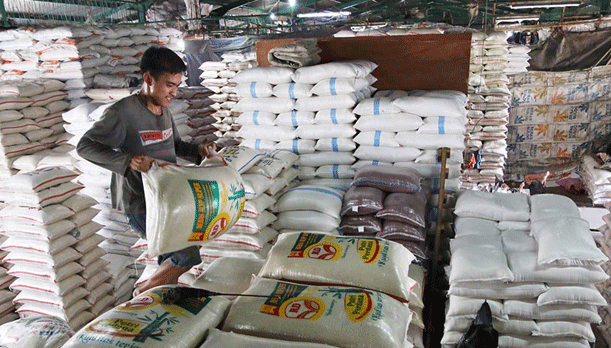
Indonesia, long known as one of the world’s largest rice consumers, is now setting its sights on becoming a significant rice exporter. However, this ambition comes with serious challenges, as noted by Khudori, an agricultural analyst with the Indonesian Association of Political Economy (AEPI). At the heart of the issue is one critical question: At what price can Indonesia export rice competitively?
High Prices Limit Global Competitiveness
Currently, the price of rice in Indonesia is about 1.5 times higher than the global market average, making Indonesian rice noncompetitive in international trade. Unlike Thailand, India, or Vietnam—countries with long-established and efficient rice export systems—Indonesia’s domestic prices rarely fall below international benchmarks.
This price gap is caused by:
- Higher production costs in Indonesia (labor, inputs, post-harvest losses)
- Supply chain inefficiencies
- Limited mechanization and infrastructure
Without competitive pricing, potential importers like Malaysia, which recently approached Indonesia for rice supply due to their own shortages and rising prices, may turn to other exporting nations.
Productivity and Planting Index: Key Bottlenecks
Indonesia’s rice production is currently just enough to meet domestic needs, and not consistently. In fact, Indonesia imported 4.5 million tons of rice in 2024 to fill supply gaps. Although the outlook for 2025 is more optimistic, sustainable export potential will require:
- Higher paddy productivity, which has been stagnant for several years
- An improved cropping index, meaning more planting cycles per year per hectare
- Increased access to water, fertilizers, certified seeds, and affordable credit for smallholder farmers
According to Survei Kerangka Sampel Area (KSA) data from February 2025, paddy production from January to May 2025 is expected to reach 34.47 million tons (GKP), which is equivalent to 16.62 million tons of milled rice—an increase of 12.4% over the same period last year.
National Stock at Historic High
Minister of Agriculture Amran Sulaiman recently noted that Indonesia’s rice stock could reach 4 million tons in May 2025—the highest level in over two decades, potentially since independence. Current reserves are already estimated at 3.3 to 3.7 million tons. This improvement reflects favorable growing conditions and increased planting efforts.
Yet, despite this record, Minister Amran emphasized that Indonesia is not yet ready to begin exports, prioritizing domestic supply stability first. “We are watching the climate. We must not risk shortages,” he said.
The Way Forward
To move from ambition to action, Indonesia must:
- Reduce production costs through modernization and better input distribution
- Invest in irrigation and mechanization
- Establish a stable buffer stock before allocating surpluses for export
- Ensure consistent quality and volume for international buyers
Indonesia’s dream of becoming a rice exporter is achievable—but only if key structural issues are addressed. With strong harvests, rising stockpiles, and supportive government policies, the foundation is being laid. However, unless the cost gap is closed and productivity increased, Indonesia may remain a rice-consuming giant rather than a global supplier.
Error