The notion of commercial rice production in Mongolia, a country known for its harsh, arid climate and nomadic herding traditions, has long been considered improbable. However, a landmark pilot project is challenging this assumption, demonstrating that with the right technology and varieties, rice can not only grow but thrive on the Mongolian steppe. This initiative could pave the way for significant advancements in food security and agricultural diversification in cold, dry regions worldwide.
The Pilot Project: Achieving Parity with Korean Yields
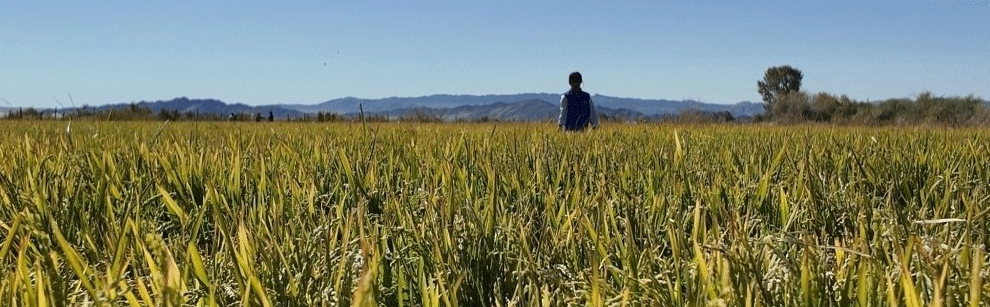
The project, led by company director Gankhuyag Jargalsaikhan in collaboration with the South Korean COPIA Mongolia Center, represents the culmination of two decades of research. In April of this year, pilot plantings were initiated on 5.3 hectares in Bulgan soum, Khovd aimag.
The results have been startlingly successful. Director Woo Myung-gyu of COPIA Mongolia, a rice expert, reported that the fields are expected to yield 6-8 tons per hectare. This range is critically important as it is equivalent to the average yield achieved in South Korea’s own cultivated fields, a country with a highly advanced rice sector. The key to this success was the strategic selection of germplasm. “By testing seeds and varieties growing in the coldest conditions of Korea, we were able to effectively cultivate rice suitable for Mongolia,” Woo explained. This approach of leveraging cold-tolerant genetics from a similar latitudinal band proved effective.
Economic and Environmental Implications: A National Opportunity
The potential macroeconomic impact of scaling this success is substantial. Mongolia currently imports approximately 68,000 tons of rice annually, valued at around $50 million. Establishing a domestic rice industry could eliminate this dependency, creating an estimated 5,000 to 8,000 new jobs and acting as a powerful economic lever for rural development.
Beyond economics, the project incorporates crucial environmental design. Gankhuyag emphasizes the importance of creating integrated systems involving lakes, ponds, and wind-protecting forest belts to maintain the natural balance. This holistic approach of agroforestry and water management is essential for mitigating Mongolia’s severe and dry climate, preventing soil degradation, and creating a viable microclimate for sustained rice cultivation.
Government Alignment and the Path Forward
The project aligns with national strategic goals. The Mongolian government, through its Ministry of Food, Agriculture and Light Industry, is actively pursuing food security initiatives like the “Food Revolution” and “Virgin Campaign IV.” State Secretary Jambaltseren Tumur-Uyaa endorsed the efforts, highlighting the importance of public-private partnerships with foreign organizations to conduct the research and analysis necessary for import substitution. This official support is crucial for securing the long-term investment needed to move from a successful pilot to a commercially viable cluster-based industry, as envisioned by the Korean partners.
A Model for Cold-Arid Agronomy
The success of this pilot project is more than a national story for Mongolia; it is a proof-of-concept for agronomists and agricultural engineers globally. It demonstrates that through:
- Strategic Germplasm Selection: Identifying and utilizing crop varieties bred for extreme conditions in analogous climates.
- Integrated System Design: Combining cultivation with essential water and wind management infrastructure.
- International Knowledge Transfer: Leveraging expertise from global leaders in specific agricultural sectors.
It is possible to develop agricultural systems in environments previously considered non-arable. For Mongolia, this means a path toward food sovereignty and economic diversification. For the global agricultural community, it provides a valuable case study in innovating under the constraints of a changing climate.
Error