New Regulations Facilitate Registration of Low-Impact Biological Control Products
The Brazilian Ministry of Agriculture and Livestock (Mapa) has published Ordinance No. 1,127, increasing the number of reference specifications (ER) for phytosanitary products approved for organic agriculture to 60. These new ERs are widely accessible and are expected to ease the registration process for products based on biological control agents.
Article
The recent expansion of reference specifications for organic agriculture products marks a significant advancement for both organic and conventional farming in Brazil. With the publication of Ordinance No. 1,127, the Ministry of Agriculture and Livestock (Mapa) has increased the number of approved phytosanitary product specifications to 60. This regulatory update facilitates the registration of low-impact biological control agents, providing farmers with a broader range of environmentally friendly options.
According to Angélica Wielewicki, head of the Reference Specifications Service of Mapa’s Agricultural Defense Secretariat, nearly 90% of biological control products registered in Brazil utilize these reference specifications. “Our expectation is that this number will increase with the new ERs,” Wielewicki stated. As of the end of May this year, Brazilian farmers had access to over 300 registered products, enhancing their ability to manage crops with minimal environmental impact.
Among the new specifications, ER59 features the parasitoid wasp Aphidius colemani as an active ingredient for managing the aphid Aphis gossypii. Although chemical pesticides are available for controlling this pest, low-impact alternatives are limited. Aphidius colemani represents the first parasitoid approved for use against Aphis gossypii in Brazil, providing an innovative and sustainable solution for pest management.
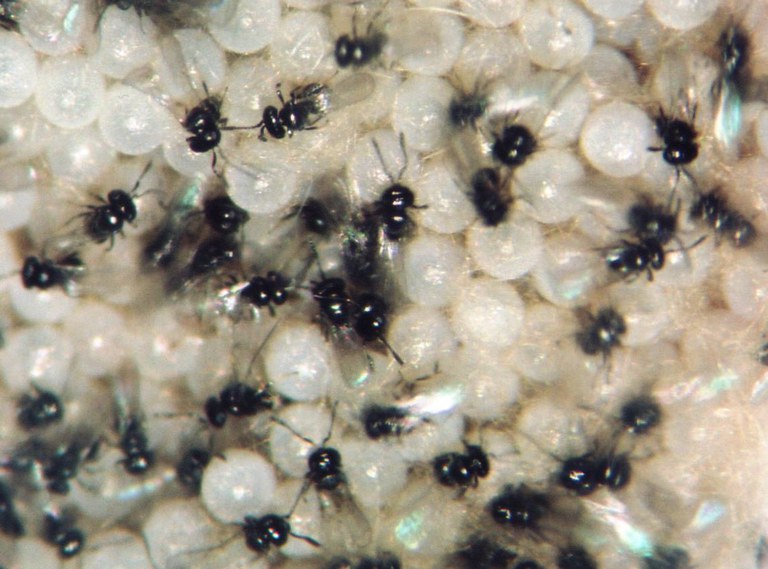
Similarly, ER60 introduces another parasitoid wasp, Telenomus remus, recommended for controlling the fall armyworm (Spodoptera frugiperda). This specification was developed with contributions from Ivan Cruz, a researcher at Embrapa Maize and Sorghum. Telenomus remus is the second parasitoid authorized for controlling this pest, complementing the previously approved Trichogramma pretiosum.
The new ordinance also revises Joint Normative Instruction SDA/SDC No. 02, dated July 12, 2013. Notably, ER25 and ER30 have been republished with significant updates. These specifications pertain to microbiological control agents and now include taxonomic classification adjustments, changes in the presentation of active ingredients, and expanded observation fields. Additionally, ER30 has been made broadly accessible and now incorporates 27 new “other ingredients” for commercial formulations.
Error