
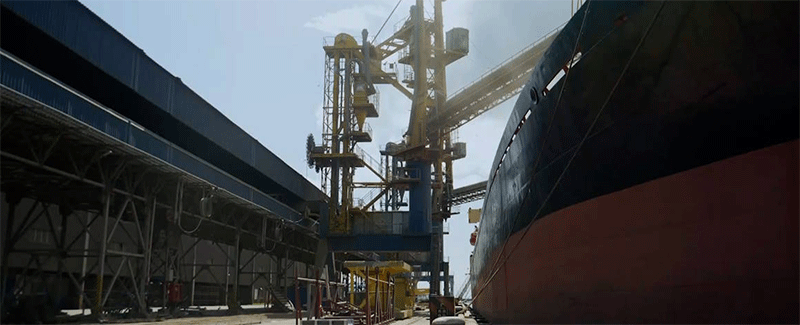
The recent confirmation by the Novorossiysk branch of Russia’s Center for Grain Quality Assessment (FGBU “TsOK APK”) of over 50,000 tonnes of wheat bound for Indonesia represents a significant milestone beyond mere volume. This shipment signals the successful reopening of a key Asian market after a period of restriction, underscoring a critical evolution in global agricultural trade: access is increasingly governed by verifiable quality and safety protocols, not just production capacity.
The resumption of exports to Indonesia, the world’s fourth-most populous country, was the direct result of collaborative work between Rosselkhoznadzor (the Russian veterinary and phytosanitary service) and Indonesia’s Quarantine Agency. A pivotal step was the August accreditation extension granted to five Russian laboratories, including the Novorossiysk branch. This accreditation empowers these facilities to conduct the full spectrum of analyses required for the Indonesian market, effectively building a bridge of trust based on scientific verification.
As stated by Tatiana Mamonova, Deputy Director of the Novorossiysk branch, Indonesian import regulations place particular emphasis on microtoxin content, pesticide residues, and the absence of GMOs. Meeting these benchmarks is a non-negotiable requirement for market entry. This aligns with a global trend where major importers are tightening food safety standards. For instance, the European Union’s Rapid Alert System for Food and Feed (RASFF) frequently notifies on mycotoxin (e.g., aflatoxin, deoxynivalenol) contamination in grain imports, leading to border rejections. By proactively adhering to and certifying against these standards, Russian exporters mitigate the risk of costly shipment rejections and protect the reputation of the entire national grain brand.
Strategic Importance in a Competitive Market
Indonesia is a major player in the global wheat market, with imports projected by the USDA to remain robust at over 11 million tonnes for the 2024/25 marketing year. Traditionally, suppliers like Australia, Ukraine, and Canada have been key players. Russia’s re-entry into this market is a strategic move to solidify its position as the world’s leading wheat exporter, a title it has held in recent seasons. This achievement demonstrates that the Russian grain industry is maturing from a volume-driven powerhouse to a quality-assured, reliable partner capable of meeting the specific demands of discerning customers.
The 50,000-tonne shipment to Indonesia is a case study in modern agricultural export strategy. It highlights that sustained market access is built on a foundation of transparent science, international regulatory cooperation, and an unwavering commitment to food safety. For farmers, agronomists, and farm owners, this underscores the importance of integrated supply chain management—from selecting appropriate varieties and implementing careful crop protection strategies in the field, to ensuring traceability and quality control at the elevator. As global competition intensifies, the ability to not only produce grain but to consistently prove its safety and quality will be the defining factor for long-term export success.
Error