The pursuit of higher wheat yields has long been tied to increased nitrogen (N) application. However, this strategy is reaching its economic and environmental limits. Excessive fertilizer use drives up production costs, contributes significantly to greenhouse gas emissions—with agriculture accounting for nearly 70% of global nitrous oxide emissions according to the IPCC—and leads to nutrient runoff that threatens water quality. The central challenge for modern agriculture is no longer just producing more, but producing more with less.
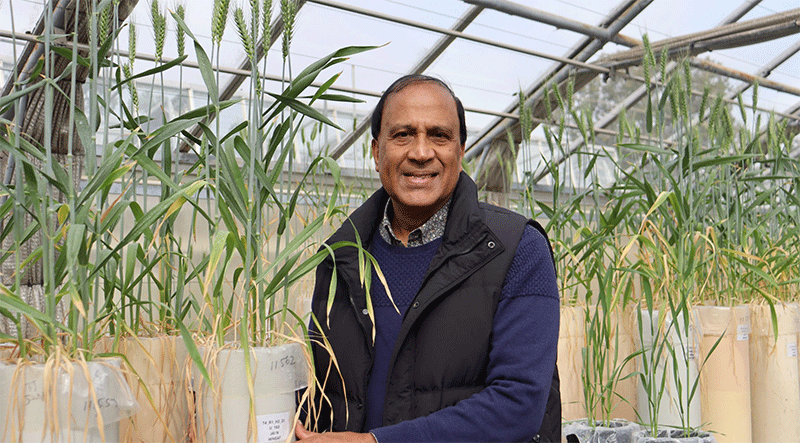
Pioneering research led by Hackett Professor Kadambot Siddique from The University of Western Australia, in collaboration with international institutions, provides a critical answer: the key to sustainable intensification lies not in the fertilizer bag, but in the very architecture of the wheat plant itself.
The Modern Breeding Paradox: High Yield at a Cost
While contemporary breeding has successfully boosted yield potential under high-input conditions, a study published in the European Journal of Agronomy highlights a significant trade-off. Modern wheat cultivars achieve markedly higher yields when nitrogen is plentiful, but their performance gains under medium and low nitrogen applications remain limited. This has inadvertently reduced the adaptability of new varieties to less favourable or low-input environments, creating a vulnerability in our food system.
The Root of the Solution: Digging Deeper into the Data
The research, spanning multiple papers, identifies the plant’s root system as the crucial lever for improving Nitrogen Use Efficiency (NUE). A publication in Field Crops Research demonstrates that modern breeding has actively strengthened wheat root systems. These improved roots are more effective at scavenging for nitrogen, enhancing its absorption from the soil and its translocation to the grain.
This is not just about plant health; it’s an environmental imperative. The study found that these efficient root systems allow the plant to recover a higher percentage of applied fertilizer nitrogen, thereby leaving less residual nitrogen in the soil. This reduces the risk of nitrate leaching into groundwater and the volatilization of nitrous oxide, a potent greenhouse gas with nearly 300 times the global warming potential of carbon dioxide over a 100-year period.
Synergy with Water: A Double Win for Dryland Agriculture
The connection between water and nitrogen is inseparable. A third study, in Plant and Soil, examined how breeding and N management shape root architecture and Water-Use Efficiency (WUE). The findings were revealing: modern cultivars have progressively improved grain water-use efficiency.
Critically, the root response is adaptive. Under reduced nitrogen conditions, wheat plants develop deeper roots to tap into subsoil moisture. Under adequate nitrogen, root growth is concentrated more in the topsoil where nutrients are abundant. This plasticity is a key trait for resilience in unpredictable climates.
As Professor Siddique states, “By effectively coordinating nitrogen distribution across vegetative tissues, we can improve nitrogen use efficiency and increase grain protein content in wheat.”
The Path to Climate-Smart Wheat
The message from this comprehensive research is clear. The future of sustainable wheat production depends on a dual strategy: optimizing plant genetics and refining management practices. Breeding programs must now prioritize the development of varieties with root systems engineered for efficient nitrogen capture and adaptability to both water and nutrient stress. This shift, coordinated with precise nutrient and water management, will unlock the potential for high yields even in challenging environments.
By focusing below the surface, farmers, agronomists, and breeders can secure the resilience and productivity of our agricultural systems, ensuring they are both profitable and sustainable for generations to come.
Error