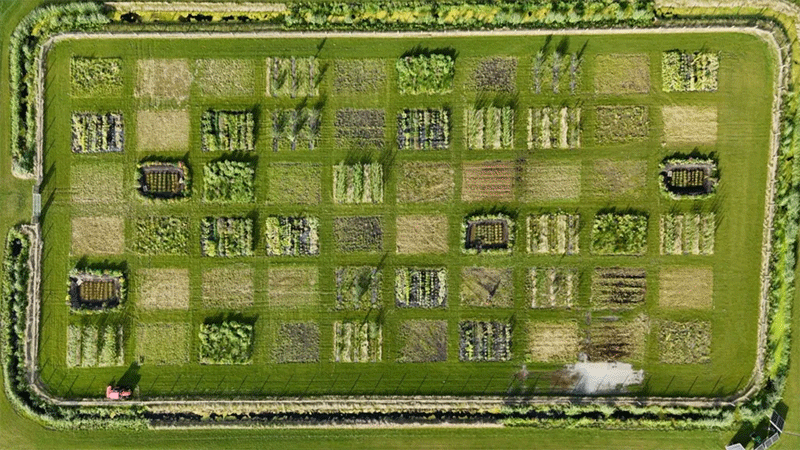
In a quiet corner of east England, an agricultural experiment that was once dismissed as a joke is now yielding tangible results. Nadine Mitschunas, an ecologist leading the UK’s first commercial rice trial, has successfully cultivated nine international varieties—from Colombian ‘Estrella’ to Italian risotto rice—in specially dug paddy fields. This initiative, a partnership between the UK Centre for Ecology & Hydrology (UKCEH) and local farmers Craig and Sarah Taylor, is not merely about adding a new staple to the British diet. It is a strategic response to a pressing dual challenge: adapting to a warming climate and mitigating the massive carbon emissions from the UK’s degrading peatlands.
The Climate Catalyst: A Hotter Britain Opens New Doors
The success of the 2024 trial was significantly aided by the UK’s hottest summer on record since 1884. This aligns with climate projections suggesting that with average annual temperatures rising 2-4°C above pre-industrial levels, rice could become a viable crop in parts of the UK. Professor Richard Pywell of UKCEH acknowledges that rice is currently at the very edge of its climatic range in Britain, making it a risky commercial venture for now. However, the trial’s purpose is to look a decade ahead, exploring what a future, warmer British agricultural landscape could sustainably support.
The Peatland Problem: A Carbon Time Bomb and an Opportunity
The location of this trial is as significant as the crop itself. The Cambridgeshire Fens sit on rich peat soil, which is some of the UK’s most productive land, generating £1.2bn in vegetable output annually. However, as this peat dries out for conventional agriculture like potatoes and onions, it oxidizes, releasing vast amounts of stored carbon. Nationally, degraded peatlands account for 3% of the UK’s greenhouse gas emissions. This creates a fundamental conflict between immediate food production and long-term environmental health.
The rice trial offers a radical solution: paludiculture, or farming on rewetted peat. By intentionally flooding fields to grow rice and other water-tolerant crops like willow and lettuce, the project aims to keep the peat waterlogged, thereby halting carbon emissions and preserving the soil itself. Initial results are promising, suggesting that the methane emissions from the rice paddies are not greater than the carbon being locked away by preventing peat oxidation.
A Broader Context: The Urgency for Systemic Change
This research is critical in the context of the UK’s overall food system footprint. A 2023 report from the Food, Farming and Countryside Commission highlighted that the UK’s food system, including imports, is responsible for 38% of the nation’s greenhouse gas emissions, with domestic agriculture accounting for 11.7%. The status quo is unsustainable. Farmers like the Taylors are acutely aware of this, noting that unpredictable weather is already impacting harvests and that they must “write their own destiny.” The rice trial represents a proactive attempt to diversify and build resilience against climate volatility.
The UK’s first rice paddy is far more than a curiosity; it is a live prototype for a necessary agricultural transition. It demonstrates a pragmatic approach to climate adaptation by testing new crops suited for future conditions. Simultaneously, it tackles the critical issue of mitigation by exploring how to productively manage carbon-rich peatlands without destroying them. For farmers, agronomists, and policymakers, the key takeaway is the need for integrated systems thinking. The future of resilient farming in the UK may not lie in choosing between food security and environmental health, but in innovating new, synergistic models—like wet peat agriculture—that achieve both. While a British-grown risotto is still years away, the data and experience harvested from this field today are already seeding the ideas that will shape the farms of tomorrow.
Error