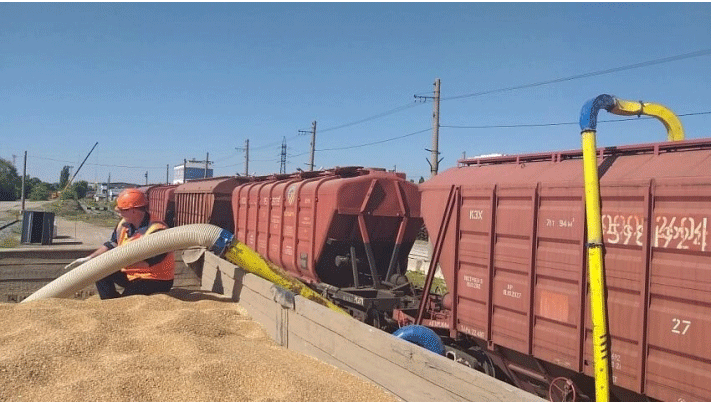
The New Silk Road for Grain: A Strategic Shift in the Caucasus
The arrival of the first 1,000-ton shipment of Ulyanovsk wheat in Armenia via a new rail route through Azerbaijan marks a pivotal moment for agricultural stakeholders across the region. While the movement of grain is routine, the pathway taken is anything but. This development signals a strategic diversification of supply chains, moving away from a heavy reliance on road transport and Georgian seaports.
For years, Armenia’s annual import of 450,000-500,000 tons of Russian grain depended almost entirely on trucking through border checkpoints or a complex sea-land route via Georgian ports. These methods, while functional, are subject to congestion, seasonal road conditions, higher fuel costs, and greater carbon emissions. The new rail link offers a compelling alternative.
The Data-Driven Advantage of Rail
The shift to rail is not merely a change of vehicle; it’s an upgrade in efficiency and predictability. According to a 2023 report by the International Transport Forum, rail freight can be up to 80% more energy-efficient than road freight for heavy commodities like grain over long distances. Furthermore, a single train can carry the load of dozens of trucks, significantly reducing road congestion and associated maintenance costs.
The economic implications are substantial. While specific tariff details for this new route are not public, industry benchmarks from the World Bank indicate that rail transport for bulk goods over distances exceeding 500km can be 20-30% cheaper than road transport. For a country like Armenia, which the FAO lists as a net food importer, reducing the cost of importing a staple like wheat directly enhances food security and price stability.
The commitment to send an additional 132 wagons of wheat by the end of January 2026 underscores the commercial confidence in this new corridor. This planned volume represents a significant and rapid scaling of operations, suggesting that the initial test run proved its viability in terms of cost, transit time, and bureaucratic smoothness, facilitated by Russian Railways (RZD).
Broader Implications for Agricultural Logistics
This new route is a case study in enhancing supply chain resilience. By creating a viable alternative to existing paths, it mitigates risks associated with any single route. For agronomists and farm owners considering export opportunities, it highlights the critical importance of monitoring evolving logistics networks. A new corridor can suddenly make a previously marginal market economically attractive.
For scientists and agricultural engineers, this development underscores the need for post-harvest logistics to be integrated into the overall agricultural production strategy. The quality preservation of grain during transit, the efficiency of loading and unloading mechanisms, and the reduction of the carbon footprint of the food supply chain are all areas where innovation is driven by such logistical shifts.
The inaugural Ulyanovsk-Armenia wheat train is far more than a one-off delivery. It is a tangible demonstration of how geopolitical shifts and infrastructure development are directly impacting agricultural markets. By providing a cheaper, more efficient, and more resilient supply line, this new rail corridor strengthens food security for Armenia and opens new strategic export avenues for Russian grain producers. For professionals across the agricultural sector, it serves as a powerful reminder that the future of farming is not just grown in the fields, but is also engineered on the rails and roads that connect producers to consumers.
Error