Siberian Surge: Krasnoyarsk Krai Cements Its Role as a Key Agricultural Exporter
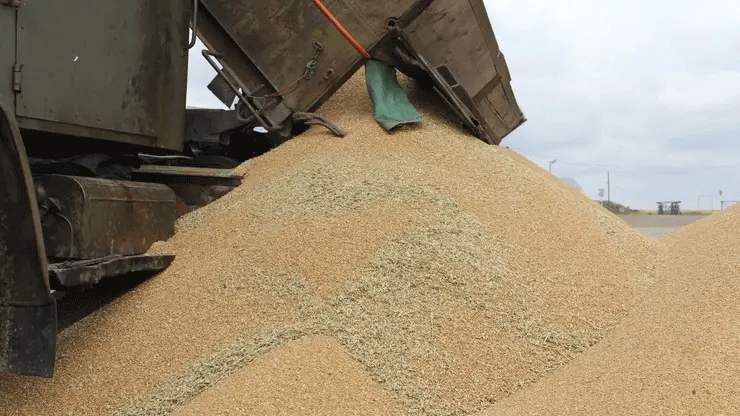
The latest data from Rosselkhoznadzor confirms a significant trend: Siberia is not just a land of vast potential but an active and growing player in the national and global grain market. Over the first 11 months of 2025, 1.8 million tons of grain, processed products, oilseeds, and peas were shipped from Krasnoyarsk Krai. Of this substantial volume, over 200,000 tons were directed to export markets, marking a deliberate and strategic outward expansion.
Diversifying Markets: From Traditional Partners to New Frontiers
The export portfolio is revealing. While traditional crops like wheat and oats remain staples, the prominence of rapeseed and peas highlights a response to global demand for oilseeds and plant-based proteins. Geopolitically, exports continue to flow to established partners in the Eurasian Economic Union (Belarus, Kazakhstan) and Asia (China, Mongolia).
However, the most noteworthy development of 2025 is the first-ever shipment of Krasnoyarsk wheat to Vietnam—2.1 thousand tons. This breakthrough is symbolic of a broader pivot. With global trade flows in flux, Russian agri-exporters are actively cultivating new relationships in Southeast Asia, a high-growth region with rising food import needs. This aligns with the national “pivot to the East” strategy and reduces market concentration risks.
Robust Domestic Logistics: Feeding the Nation’s Peripheries
Perhaps even more impressive is the scale of domestic distribution: 1.6 million tons shipped within Russia, representing a 12% year-on-year increase. The destinations are strategically significant: Kaliningrad and Leningrad Oblasts (serving the Baltic sector), Krasnodar Krai (a key processing and re-export hub on the Black Sea), and Primorsky Krai (the gateway to Asia).
This domestic network is crucial. It demonstrates that Siberian grain is competitively integrated into the nation’s entire food security and value-added chain, supplying distant regions where local production may be insufficient or where it is further processed for re-export.
Context and Driving Forces
This performance is not an anomaly. It builds on Russia’s record wheat harvests and its position as the world’s top wheat exporter. The 2023/24 season saw Russian wheat exports exceed 52 million tons globally. Krasnoyarsk’s growth contributes to this scale while leveraging its geographic position for eastward and southward routes.
Key drivers include:
- Infrastructure Investment: Ongoing development of railway capacity and port facilities in Russia’s Far East.
- Agricultural Technology: Adoption of precision farming and hardy crop varieties suited to the Siberian climate, improving yields and quality.
- Policy Support: State programs facilitating export logistics and market access.
The data from Krasnoyarsk Krai tells a story of strategic diversification and logistical maturity. It is no longer merely a producer but a dynamic trading region, successfully balancing robust domestic supply with agile export market development. The inaugural shipment to Vietnam is a clear signal of ambition. For farmers and agronomists, this underscores the importance of crop selection aligned with export demand. For engineers, owners, and scientists, it highlights the critical need for continued innovation in logistics, storage, and crop adaptation to sustain this growth. Siberia’s agricultural corridor is open for business, and its influence on Russia’s agrarian economy is set to expand.
Error