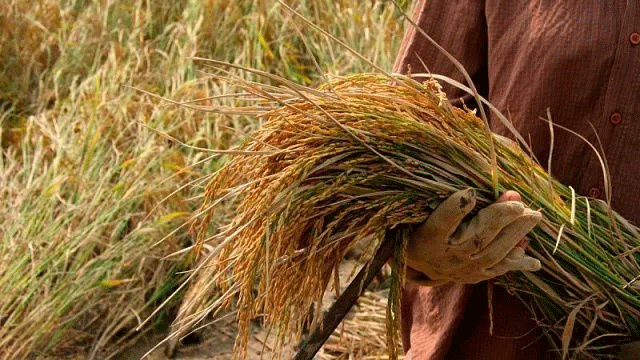
The year 2025 marks a historic turning point for Indonesian agriculture. The nation has achieved a long-sought goal: complete self-sufficiency in rice and corn, eliminating imports for these staple commodities. This strategic milestone is underpinned by record-breaking domestic production and bolstered by state reserves of rice reaching approximately 4 million tons—an all-time high. This buffer proved its value in November, allowing the government to effectively support provinces devastated by floods using entirely domestic stocks.
The domestic drivers of this success are clear and instructive. The government’s pivotal intervention was the increase and stabilization of guaranteed purchase prices for rice, directly incentivizing farmer production. This policy, coupled with active technological adoption and land expansion in regions like Kalimantan, yielded dramatic results. Official statistics (BPS) forecast 2025 rice production at 34.77 million tons, a staggering 13.54% year-on-year increase. Corn production is estimated to reach 2.8 million tons in Q4, supporting the poultry and livestock sectors, with an annual target of 4 million tons. This production surge has had a startling global impact. Indonesia’s withdrawal from the international rice market is cited as a key factor in the near-halving of global rice prices, from approximately $650 to $340 per ton.
This achievement aligns with broader global trends where food security concerns are prompting nations to prioritize domestic production. According to the FAO’s 2024 report, increasing climate volatility and geopolitical tensions have accelerated investments in agricultural self-reliance worldwide. Indonesia’s model—combining price supports, technology push, and strategic land use—offers a compelling case study. Looking ahead, the new administration under President Prabowo Subianto has set an ambitious follow-on goal: ending dependence on white sugar imports by 2026, with soybeans and wheat also in focus for future import substitution programs.
Indonesia’s journey to grain self-sufficiency is more than a national success story; it is a powerful lesson in agricultural policy and market dynamics. For farmers and agronomists, it demonstrates the catalytic effect of stable, profitable pricing on adoption of technology and yield expansion. For scientists and engineers, it underscores the critical role of innovation in achieving such rapid production growth. For farm owners and global market observers, it highlights how decisive national policy can not only ensure domestic food security but also significantly alter global commodity prices and trade flows. As Indonesia pivots to its next targets in sugar and other crops, its agricultural strategy warrants close attention from the global agri-community.
Error