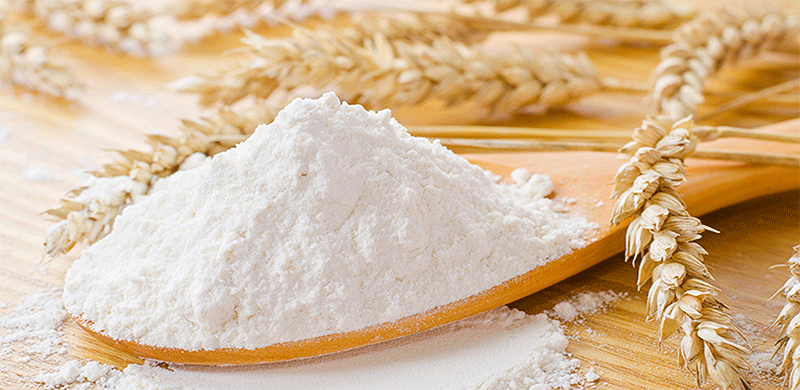
In a seemingly contradictory forecast, Russia’s agricultural sector is poised for a year of both abundance and contraction. According to a presentation by Igor Sviridenko, President of the Russian Union of Millers and Cereal Enterprises, at the “Mill-2025” business conference, the nation’s flour production in 2025 is projected to fall by 5.6% to 9.4 million tons, down from 9.932 million tons in 2024. This decline is expected across the board: wheat flour output is predicted to drop to 8.77 million tons (from 9.67 million), rye flour to 470,000 tons (from 500,000), and cereal production to 1.85 million tons (from 1.914 million).
This projected downturn is particularly notable because it follows a stronger 2024 and occurs against a backdrop of robust grain harvests. Sviridenko himself highlighted that Russia’s wheat production has exceeded 80 million tons for seven consecutive years, with the 2025 harvest forecasted to reach 85.7 million tons, up from 82.6 million tons in 2024. This presents a central question: why would flour production fall when raw material supplies are more than sufficient?
The answer lies not in quantity, but in quality and data integrity. Sviridenko injected a crucial note of caution regarding the official data from Rosstat, suggesting that flour production figures are likely underestimated as they are based on voluntary reporting. However, in the absence of alternative data, these numbers are the best available metric. More importantly, he pinpointed the core issue: while Russia produces vast amounts of wheat, the milling industry requires high-quality grain with specific protein and gluten characteristics.
The most telling data point from the forecast is the dramatic projected increase in the production of high-quality Class 3 wheat, which is expected to surge to 32.4 million tons in 2025 from 26.9 million tons in 2024. This 20% increase in premium wheat supply reveals that the market is responding to demand, but it also underscores that a significant portion of the total harvest may consist of lower-class wheat unsuitable for high-grade flour without blending or processing adjustments. This aligns with global trends; a 2024 report from the International Grains Council (IGC) emphasized that the price spread between high-protein and feed-quality wheat is widening globally, reflecting the increasing premium placed on quality for food processing. The Russian milling industry’s challenge is not a lack of grain, but the economic and logistical hurdle of sourcing the right type of grain consistently.
The projected 5.6% drop in Russian flour production is not a story of scarcity but one of selectivity and market evolution. It highlights a critical maturation in the agricultural sector: the value is increasingly defined by quality specifications rather than sheer volume. For farmers, this signals the growing importance of cultivating high-quality, Class 3 wheat varieties to meet specific industrial demand. For agronomists, millers, and exporters, it underscores the need for efficient grain segregation and supply chain management to ensure that the abundant harvest translates into profitable, high-value end products. The era where total tonnage was the primary indicator of success is giving way to a more nuanced reality where quality metrics are paramount.
Error