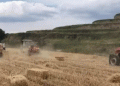
According to preliminary data from Rosstat, Russia’s 2025 harvest has reached 139.4 million tons of grain in clean weight, marking a notable increase of 10.7% from the 2024 result of 125.9 million tons. This robust performance underscores the continued strength of the country’s grain sector. The data, encompassing all farm categories, also details output for key commodities: 17 million tons of sunflower seeds (a slight 0.6% increase), 43.6 million tons of sugar beet (a 3.3% decrease), 19.5 million tons of potatoes (a significant 9.4% increase), and 13.8 million tons of vegetables (a marginal 0.9% decrease).
A critical analysis of the data reveals a persistent structural divide in Russian agriculture. Large agricultural organizations dominate the production of field crops, accounting for 69.5% of grain, 89.2% of sugar beet, and 58.8% of sunflower seeds. Conversely, household farms (personal subsidiary plots) remain crucial for the food basket, producing the majority of potatoes (56.6%) and nearly half of all vegetables (47.0%). The role of peasant (farmer) enterprises is most pronounced in oilseeds, where they contributed 40.8% of the sunflower harvest, and in grains, with a 29.3% share. This distribution aligns with a 2024 USDA Foreign Agricultural Service report on Russia, which notes that while large agro-holdings drive export-oriented grain volumes, small-scale producers are essential for domestic food security and market diversity.
However, early indicators for the 2026 season present a note of caution. As of December 1, 2025, winter grain sowings in agricultural organizations covered 10.9 million hectares, down 2.8% year-on-year. Furthermore, fallow land plowed (зябь) stood at 16.8 million hectares, compared to 18.4 million hectares at the same date in 2024. These reductions, as noted in recent analyses from the IKAR agricultural consultancy, could reflect adjustments to regional weather patterns, economic factors like input costs, or strategic crop rotation decisions, potentially influencing next year’s yield potential.
Russia’s 2025 harvest solidifies its position as a global grain powerhouse, demonstrating the sector’s capacity for significant year-on-year growth. The data also paints a clear picture of a dualistic agricultural economy: one dominated by large, efficient enterprises focused on export commodities, and another comprising numerous smallholders who are the backbone of domestic potato and vegetable supply. The slight contraction in winter sowing and fallow area for 2026 serves as a reminder that this productivity exists within a dynamic system sensitive to economic and environmental factors. For industry observers and participants, the key takeaway is the continued evolution of this structure and the need to monitor how both large and small farm sectors adapt to changing conditions.
Error