

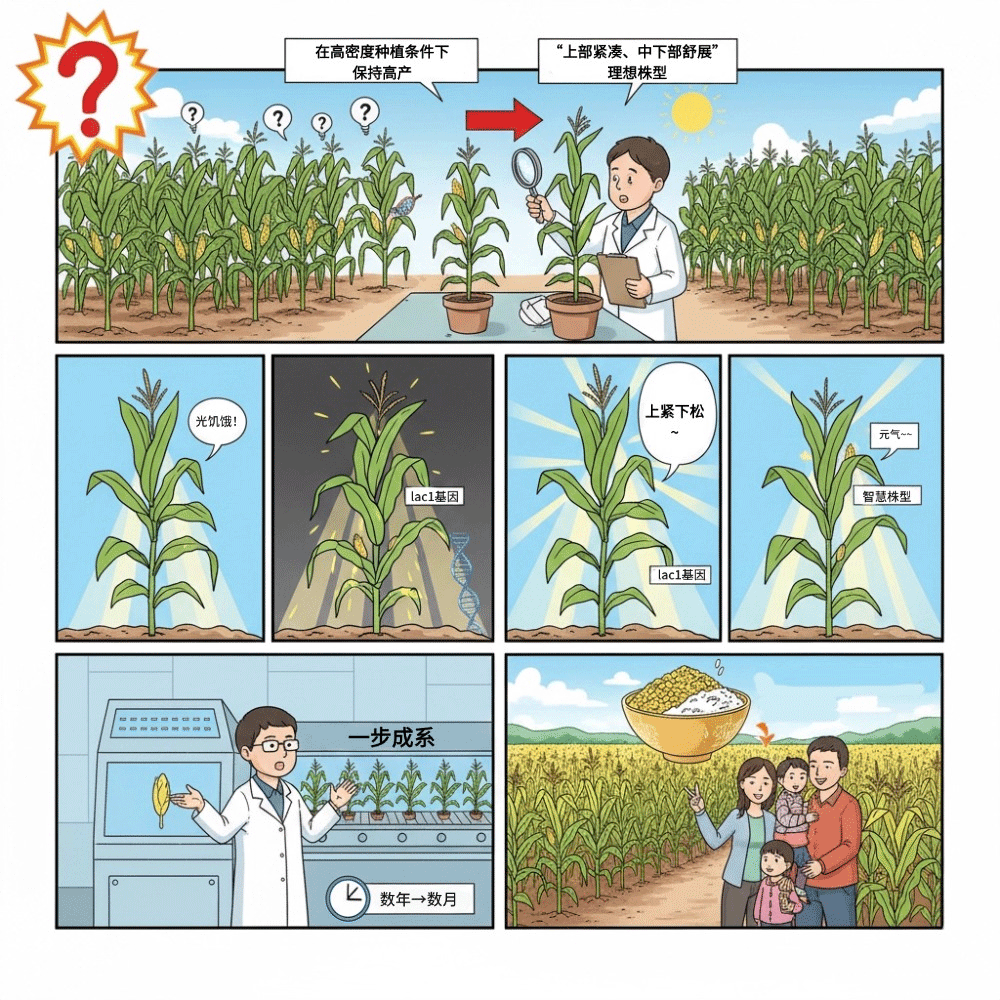
A landmark study from China Agricultural University, led by professors Tian Feng and Li Jigang, is poised to redefine the fundamentals of maize breeding and high-density planting. Published in Nature in June 2024 and highlighted in the 2025 Report on Major Advances in Agricultural Science in China, the research identifies the lac1 gene as the molecular architect of a “smart canopy” plant structure: one with tightly angled upper leaves and looser, more expansive lower leaves. This “smart” architecture directly addresses the core challenge of dense planting—shade avoidance—by optimizing light capture throughout the canopy, particularly for the crucial “ear leaves” that feed the grain.
Bridging the Yield Gap with “Smart” Architecture
The yield potential of this discovery is immense. Currently, China’s average maize planting density is about 67,500 plants per hectare (4500 plants/mu), significantly lower than the U.S. average of approximately 97,500 plants per hectare (6500 plants/mu). This gap is largely due to plants’ negative response to crowding, where they allocate energy to stem elongation instead of grain production under shade. The lac1 gene provides a biological solution. Field trials demonstrated that plants with this gene mutation maintained a superior light penetration profile in the middle and lower canopy under high density, leading to a measurable increase in photosynthetic rate and, crucially, higher group yield. This gene enables a form of “cooperation” within the crop stand, turning competitive neighbors into a collaborative, high-output system.
The Breeding Revolution: From Years to Months
Perhaps as transformative as the gene discovery itself is the accompanying breeding technology. The team developed a “one-step line creation” (Haploid-Inducer Mediated Genome Editing, HI-Edit) system. This integrates haploid induction technology with CRISPR gene editing, allowing breeders to create pure, genetically edited lines in just 8-10 months. This slashes the traditional 3-4 year timeline required for trait introgeneration using marker-assisted selection. The team successfully applied this system to edit the lac1 gene in 20 inbred lines with a 6.8% efficiency, and the improved commercial hybrids showed clear yield advantages in field tests.
From Precision to “Smart Design” in Agriculture
This research represents more than a single trait improvement; it signals a paradigm shift in crop breeding. It moves the objective from creating uniformly compact plants to engineering “smart” plants capable of dynamic, layered architectural responses to their microenvironment. For farmers and agronomists, the practical implication is a future generation of maize hybrids that can reliably sustain higher planting densities, translating directly to higher per-hectare yields. For agricultural engineers and scientists, it validates the power of integrated approaches, combining deep genetic insight with disruptive breeding logistics. For farm owners and seed industry leaders, it underscores that the next leap in productivity will come from biological efficiency and speed-to-market enabled by genomic tools. The journey from lab to field still requires robust testing and collaboration, but the path to closing the density yield gap is now not just visible, but genetically programmable.