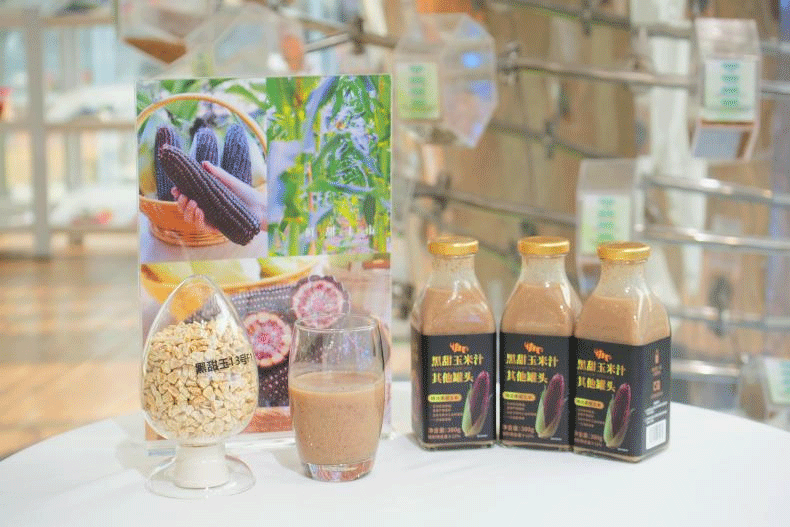
In Wenjiang District, Chengdu, the story of “Black Sweet Jade” corn is redefining value creation in agriculture. More than just a novel crop, it represents a systemic approach to overcoming the classic hurdles of specialty produce: small scale, fragmented chains, and low profitability. Bred by Chengdu Agricultural Science and Technology College, this corn boasts a high anthocyanin content (719mg/kg), a sweet, edible raw “bursting” texture, and robust agronomic traits like broad adaptability and dual-season planting, making it ideal for commercialization.
The true innovation, however, lies in the seamless pipeline built around it. The model hinges on three interconnected pillars:
- A Bridgehead for R&D: The “Chuannongniu Science Innovation Farm” in Gaoshan Village acts as a physical nexus. It aggregates resources from 12 chief scientists, including Academician Rong Tingzhao, and 42 R&D teams, serving as a testing ground and incubator. Here, “Black Sweet Jade” moved from lab to pilot plots. Complementing this, a 26-member team of local science commissioners provides tailor-made, full-chain technical support, ensuring cultivation protocols translate successfully to farm-level quality and yield.
- A Transmission Axis of Collective Economy: The village collective economic organization is activated as the core operational entity. Gaoshan Village employs a “R&D Institute + Collective Organization + Leading Enterprise + Farmers” model. Farmers contribute land as shares to a cooperative, enabling unified, scaled management. This transforms farmers into shareholders and wage-earners, with income from land rent, employment, and profit dividends. The first 3,000 kg of corn sold out instantly online, delivering tangible market benefits directly to participants, with premium rates reportedly up to 300%.
- An Extended Value Chain: The product journey extends far beyond the fresh cob. Almost concurrently with the fresh market launch, R&D began on deep-processed goods. A zero-additive fresh corn juice debuted at an agricultural expo, garnering significant interest. Plans are underway for corn sparkling water, wine, and tea. This shift from selling by weight (“by the jin“) to selling branded beverages (“by the bottle”) captures significantly higher margins. The products are now targeting major retail chains like Hualian, Sam’s Club, and Hema for 2026.
This “Wenjiang Practice” is a deliberate methodology. It is characterized by market-guided R&D, an entity-based technology transfer platform, a revitalized collective economic organization, and full-industry chain integration. This same framework is being replicated in a “Rice+” project in Wenjiang, which packages seeds, technology, and market access to develop products like glutinous rice wine and rice cakes, boosting the value of staple crop systems.
The “Black Sweet Jade” case study offers a powerful template for global agri-professionals. It demonstrates that capturing value in modern agriculture requires more than an excellent cultivar; it demands an integrated ecosystem. For scientists and agronomists, it underscores the need for breeding programs attuned to both consumer trends and farm-level resilience. For farm owners and engineers, it highlights the efficiency gains from scaled, collective operation and tech-supported precision. For policymakers and entrepreneurs, it proves the viability of models that formally link research, production, and marketing through cooperative structures. The key takeaway is the transformation of scientific innovation from a “key variable” into the “maximum increment” for industry upgrade, shared prosperity, and resilient food systems.
Error