• About
  • Advertise
  • Careers
  • Contact
Thursday, January 29, 2026
  • Login
No Result
View All Result
Field Crops news
  • Home
  • News
  • AgroTech & Innovation
  • Science
  • Sustainability
  • Market News
  • Research & Development
  • Home
  • News
  • AgroTech & Innovation
  • Science
  • Sustainability
  • Market News
  • Research & Development
No Result
View All Result
Field Crops news
No Result
View All Result
Home Climate

Beyond Wheat: How a Mountain Institute is Pioneering Climate-Resilient Agriculture with Triticale and Deep Processing

by Tatiana Ivanova
13 December 2025
in Climate, News
0
Beyond Wheat: How a Mountain Institute is Pioneering Climate-Resilient Agriculture with Triticale and Deep Processing
0
SHARES
8
VIEWS
Share on FacebookShare on Twitter

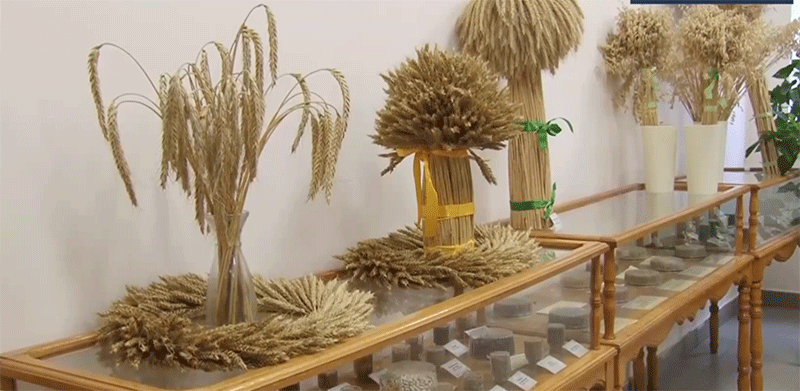
At the North Caucasus Research Institute of Mountain and Foothill Agriculture, science meets meticulous, hands-on craftsmanship. Researchers engage in the labor-intensive process of hand-selecting individual seeds, separating the small, diseased, or damaged grains to ensure genetic purity for breeding. This foundational work supports the institute’s three core, forward-looking missions: advanced seed breeding, establishing a robust domestic deep-processing industry for grains, and creating sustainable animal feed systems.

The institute’s bread and butter is developing locally-adapted varieties of cereals and forage crops. A standout focus is on triticale, a hardy hybrid of wheat and rye noted for its exceptional storm resistance. All new varieties undergo rigorous state commission testing. In a strategic move to address regional aridity, the institute collaborates with Iraqi scientists, exchanging drought-resistant breeding materials. Once a new variety is patented, the institute initiates primary seed production, generating “super-elite” original seeds before scaling up through a meticulous four-year propagation scheme across different climatic zones, from Rostov to Crimea.

Perhaps the most ambitious vision lies beyond the field. The institute is advocating for the deep processing of soft wheat varieties into high-value products like specialty starches, glucose syrups, biogas, amino acids, and feed supplements—products Russia currently imports due to a lack of domestic processing plants. This represents a significant, unoccupied niche in the national agro-industrial complex. Concurrently, the institute’s zootechnical research focuses on developing optimized animal feed rations that increase meat or milk yield while reducing overall feed volume. This work is part of a broader commitment to “biologization”—eschewing chemical fertilizers in ecologically sensitive mountain zones in favor of sustainable practices.

The work in North Ossetia is a microcosm of the strategic priorities needed for modern, resilient agriculture. It demonstrates that progress hinges on a triad of factors: genetic sovereignty through local breeding adapted to specific climates and challenges; economic sophistication by capturing more value from raw commodities through processing; and ecological responsibility via sustainable practices. While the institute highlights very real needs for better equipment and young scientific talent, its blueprint—combining traditional breeding care with a vision for high-tech bio-refining and sustainable husbandry—offers a compelling model for regional agricultural development that balances productivity, profitability, and environmental stewardship.

Error

Tags: Agricultural ResearchbiologizationClimate Resiliencedeep processingDrought Resistancemountain farmingseed breedingsustainable feedtriticalevalue-added agriculture

Tatiana Ivanova

Next Post
The Moroccan Milling Scandal: A Crisis of Oversight and a Sector in Need of Structural Reform

The Moroccan Milling Scandal: A Crisis of Oversight and a Sector in Need of Structural Reform

Newsletter

Russia Emerges as Africa’s Key Wheat Supplier: Implications for Agricultural Markets

Russia Emerges as Africa’s Key Wheat Supplier: Implications for Agricultural Markets

18 October 2024

The Kansas Corn Conundrum: Economic Engine or Aquifer’s Demise?

12 October 2025

Tunisia Secures 75,000 Tons of Soft Wheat Amid Competitive Global Bidding

26 April 2025

Russia’s Wheat Crisis: How Climate Change Is Reshaping Global Agriculture

23 January 2025

Unveiling the Genetic Blueprint of Maize: Key Genes Shaping Plant Architecture for Future Breeding

6 March 2025

Crimean Wheat Quality 2025: 63% Meets Food-Grade Standards – Key Insights for Agribusiness

21 July 2025

Hybrid Wheat Innovations: Paving the Way for Resilient and High-Yielding Crops

22 February 2025

The Disappearing Class: Why Oryol Region’s Premium Wheat Harvest is Shrinking

17 October 2025

Moscow Region’s Agricultural Surge: Winter Wheat Leads 21% Yield Increase Amid Strategic Sowing

4 November 2025

India’s Wheat and Rice Stocks Hit Record Highs: Timely Rains Shield Crops from Heat Stress

23 April 2025
  • About
  • Advertise
  • Careers
  • Contact
Call us: +51 93 999 5140

© 2020-2024 Field Crops news

Welcome Back!

Login to your account below

Forgotten Password?

Retrieve your password

Please enter your username or email address to reset your password.

Log In
No Result
View All Result
  • Home
  • News
  • Science
  • Sustainability
  • AgroTech & Innovation
  • Market News
  • Science
  • Research & Development
  • About
  • Contact

© 2020-2024 Field Crops news