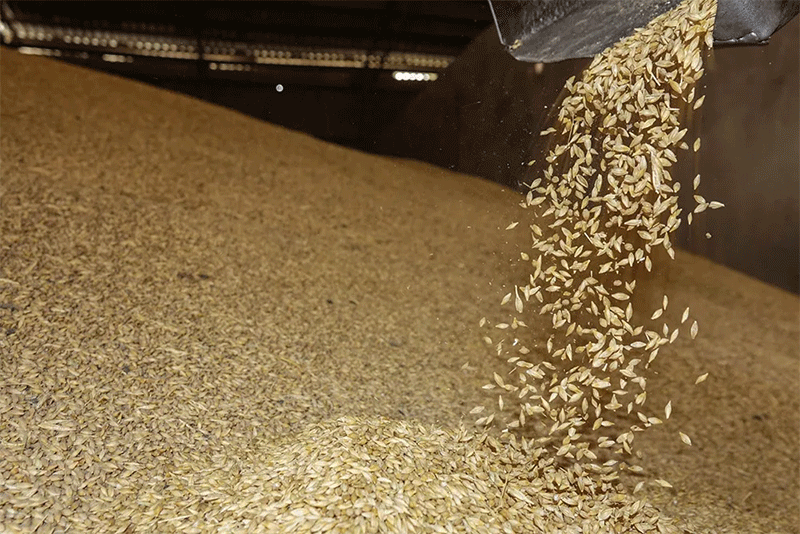
Export data from Russia’s Kurgan Oblast to China for 2025 reveals a nuanced trade picture. While the total volume of grain exports to China saw a slight decrease of approximately 2,000 tonnes, settling at over 23,000 tonnes, this marginal shift belies more significant underlying trends. The shipments, monitored and cleared by the Ural division of Rosselkhoznadzor (the Federal Service for Veterinary and Phytosanitary Surveillance), underwent mandatory phytosanitary controls and laboratory testing to ensure strict compliance with China’s import requirements. This rigorous process is non-negotiable for market access, as China maintains a stringent zero-tolerance policy for quarantine pests and mycotoxins in imported grains and oilseeds. The slight contraction in grain volume could be attributed to various factors, including logistical adjustments, internal Chinese reserve levels, or competitive pressure from other global suppliers, rather than a loss of confidence in Russian product safety.
The most striking element of Kurgan’s export profile is not grain but oilseeds. Oilseed flax continues to be the cornerstone of the regional agricultural trade with China, constituting a dominant 86% of Kurgan’s total export value to that market. In November 2025 alone, 20,200 tonnes of flax were shipped, a volume consistent with the previous year, demonstrating stable, high-volume demand. This aligns with broader global trends; China is the world’s largest importer of oilseeds to feed its massive livestock and edible oil industries, and Russia has become a key supplier. The export of smaller quantities of oats and buckwheat (1,600 tonnes) further illustrates diversification into niche, high-value cereal markets. The overarching context, as highlighted by Russian officials, is Russia’s solidified role as a top-three global grain exporter, a position that grants it significant influence in global food security dynamics. Maintaining this position, especially in premium markets like China, depends entirely on the twin pillars of consistent high-volume production and unwavering commitment to quality and phytosanitary standards, as evidenced by the successful clearance of all Kurgan shipments.
The 2025 export data from Kurgan Oblast to China illustrates a mature and strategically focused agricultural trade relationship. The minor dip in grain exports is less consequential than the robust and steady demand for oilseed flax, which remains the region’s export powerhouse. For farmers and agribusinesses in similar contexts, the key lessons are clear: deep integration into specific, high-demand supply chains (like oilseed flax for China) can provide more stability than broader commodity grain exports. Furthermore, this case reaffirms that in today’s global market, production volume alone is insufficient. Long-term export success is fundamentally tied to a reputation for reliability and rigorous adherence to the importing country’s phytosanitary and quality protocols. Investments in certified storage, traceability, and quality control labs are not just regulatory costs but essential investments in market access and premium positioning.
Error