

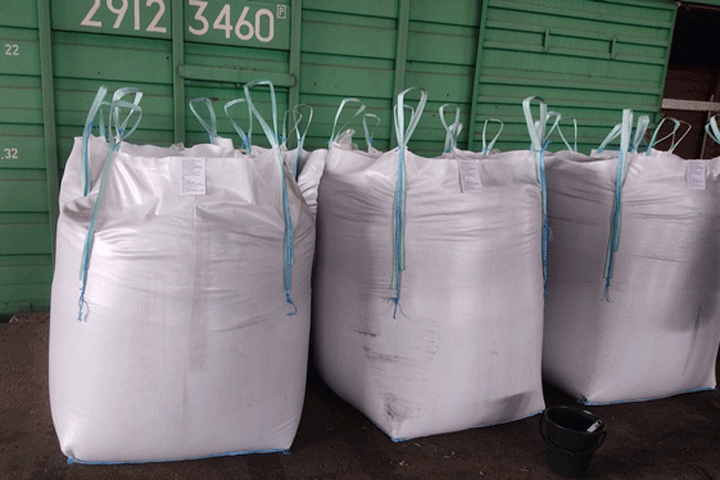
When we think of Russia’s agricultural powerhouses, regions like Krasnodar or the Black Earth zone often come to mind. However, data from the first nine months of 2024 reveals a compelling story of growth from a less-heralded region: Khakassia. The Rosselkhoznadzor office for the Republics of Khakassia and Tuva reports that from January 1 to September 30, over 26,000 tonnes of grain and processed grain products were successfully exported, primarily to China and Mongolia.
This export volume, meticulously monitored for phytosanitary compliance, signals a significant shift. It demonstrates that with the right strategy and quality controls, even regions outside traditional agricultural heartlands can secure a foothold in competitive international markets.
Deconstructing the Export Basket: Oats Lead the Charge
A breakdown of the export portfolio is particularly revealing. The data shows a clear specialization:
- Oats: >13,000 tonnes (over 50% of total exports)
- Rapeseed: ~5,500 tonnes
- Wheat Bran: >4,000 tonnes
- Other: Wheat, Flax, and Wheat Flour
The dominance of oats is a strategic masterstroke. Global demand for oats, driven by the health and wellness trend and its use in animal feed, remains strong. According to a recent report by IndexBox, the global oat market is projected to reach a volume of 27.5 million tonnes by 2030, with Asia-Pacific being a key consumption growth region. Khakassia is positioning itself directly in the path of this demand.
Furthermore, the significant volume of wheat bran (~4,000 tonnes) highlights a key trend in modern agribusiness: the valorization of by-products. No longer just a low-value residue, bran is a high-fiber ingredient sought after for the compound feed industry, turning what was once a secondary product into a valuable export commodity that boosts overall farm profitability.
The Logistics and Quality Imperative
The success of these exports hinges on two critical factors: logistical access and phytosanitary integrity. The report confirms that all shipments met the strict quarantine and phytosanitary requirements of the destination countries. For buyers in sensitive markets like China, this certification is non-negotiable. It acts as a “passport” for the goods, assuring importers of their safety and freedom from regulated pests and diseases.
This aligns with a global push for greater traceability and food safety. A failure in phytosanitary controls can lead to costly shipment rejections, port closures, and long-term reputational damage. Khakassia’s flawless record to date is a testament to robust local production and inspection systems, providing a foundation of trust upon which to build future trade.
The export performance of Khakassia is more than a regional success story; it is a case study in strategic agricultural development. It demonstrates the power of focusing on niche, high-demand crops like oats, fully leveraging by-products like wheat bran, and building an uncompromising reputation for phytosanitary quality. For farmers, agronomists, and policymakers in similar regions, Khakassia’s model proves that geographic location is less important than strategic positioning. By aligning production with global demand and ensuring ironclad quality controls, emerging agricultural regions can successfully integrate into the international supply chain and drive rural economic growth.
Error



