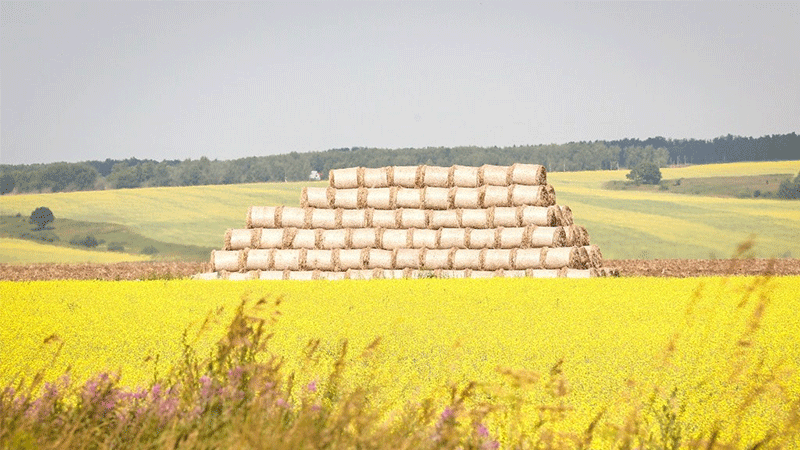
The recent comprehensive quality assessment of the 2025 harvest of ‘Yakov’ feed oats from Kotelniki, Moscow Region, serves as a potent case study for producers and consumers of animal feed. While the confirmation of compliance with GOST standards is a positive outcome, it’s the underlying data and its implications that deserve a closer look from industry professionals.
The analysis, conducted by the Central Feed and Food Quality Assessment Center, focused on two critical areas: safety and nutritional value.
A Closer Look at Safety: Heavy Metals, Mycotoxins, and Radionuclides
The results for radionuclides are particularly telling. The sample showed specific activity levels of Strontium-90 at 0.6 Bq/kg and Cesium-137 at 3.0 Bq/kg, which are significantly below the maximum permitted levels (100 and 180 Bq/kg, respectively). This is excellent news, but it should be viewed in the context of a broader global challenge.
While radionuclide concerns are region-specific, contamination from mycotoxins and heavy metals is a universal and growing threat to livestock health and productivity. A 2023 global survey by BIOMIN noted that over 60% of feed and raw commodity samples analyzed were contaminated with at least one mycotoxin. The most prevalent, Deoxynivalenol (DON or vomitoxin), can suppress immune function and reduce feed intake, leading to significant economic losses. The fact that the ‘Yakov’ oats passed these safety parameters is a testament to good agricultural and storage practices, mitigating a risk that costs the global industry billions annually.
Nutritional Profiling: The Key to Precision Feeding and Cost Efficiency
Beyond safety, the laboratory’s analysis of crude fat, crude protein, and other key nutritional indicators is where the real value for farm economics lies. Consistent nutritional data is the foundation of precision feeding.
Modern livestock and dairy operations rely on precise ration formulation to optimize animal health, growth rates, and milk yield. According to recent research from the University of Illinois, variability in the nutrient composition of just one key ingredient like oats can lead to feed cost inefficiencies of 3-5%. By verifying the nutritional profile of a batch of oats, nutritionists and farm owners can formulate diets with greater accuracy, avoiding both under-feeding (which hampers performance) and over-feeding (which wastes expensive supplements and concentrates).
The Bigger Picture: Quality Assurance as a Strategic Investment
The Moscow Ministry of Agriculture and Food rightly emphasizes that regular laboratory control supports the region’s high agribusiness standards. This should be viewed not as a cost, but as a strategic investment. In an era of volatile commodity prices and increasing consumer scrutiny, verified quality and safety are powerful market differentiators.
For a farm owner, using certified safe and nutritionally consistent feed translates directly into:
- Reduced veterinary costs and lower mortality rates.
- Improved Feed Conversion Ratios (FCR).
- Enhanced product quality (e.g., milk solids, meat marbling).
- Strengthened export credentials, as international markets demand verifiable safety data.