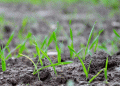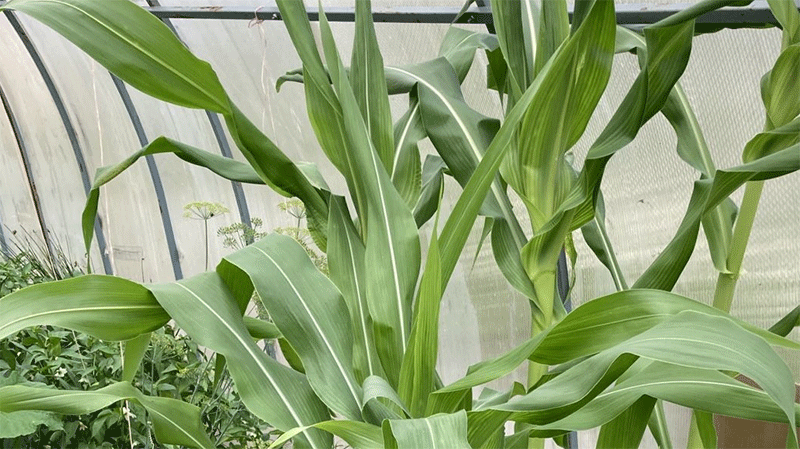
In a significant agricultural development for northern latitudes, the Komi Republic in Russia’s far northwest is set to dramatically scale up its cultivation of corn for silage. Following a successful 98-hectare pilot program across three farms, local agricultural enterprises plan to double or even triple their planting areas next year. The initiative, championed by acting Agriculture Minister Sergey Yeldin, is a direct response to the “excellent” results of the 2025 harvest, which demonstrated the viability of corn as a high-quality feed source for the region’s dairy cattle. This push is part of a broader strategy to enhance the local forage base with crops of “maximum nutritional value,” moving beyond traditional options.
The motivation for this shift is rooted in corn silage’s superior feed profile. As noted in the regional report, it is considered the best feed for cattle due to its optimal balance of sugars and starch for energy, alongside digestible fiber. Furthermore, its high levels of vitamins C and E, calcium, and potassium contribute to overall animal health and productivity. This focus on high-energy forage is critical for improving milk yields. While specific yield data from Komi’s 2025 harvest is not provided, the region’s historical archives from the mid-20th century show that with proper agronomic management—including fertilization and cultivation—yields of 300-600 centners of green mass per hectare were achievable, with peaks of up to 850-1000 centners in optimal local conditions. This historical precedent proves the crop’s potential in the region’s unique conditions, characterized by long daylight hours that can accelerate growth. The expansion plan is further supported by a government commitment to bring at least 1,000 new hectares of agricultural land into circulation annually through cadastral and land improvement works.
The Komi Republic’s ambitious corn expansion is more than a local experiment; it is a case study in agricultural adaptation in a changing climate. It demonstrates that with modern hybrid varieties and precise agronomy, high-energy forage crops can be successfully cultivated further north than traditionally believed. For farmers, agronomists, and policymakers in similar boreal and sub-arctic regions, Komi’s experience offers a powerful model for increasing regional food security and farm profitability by enhancing the quality, not just the quantity, of the forage supply. The key to long-term success will be the continued selection of appropriate early-maturing hybrids and the transfer of knowledge on northern-specific cultivation techniques to ensure consistent yields.
Error