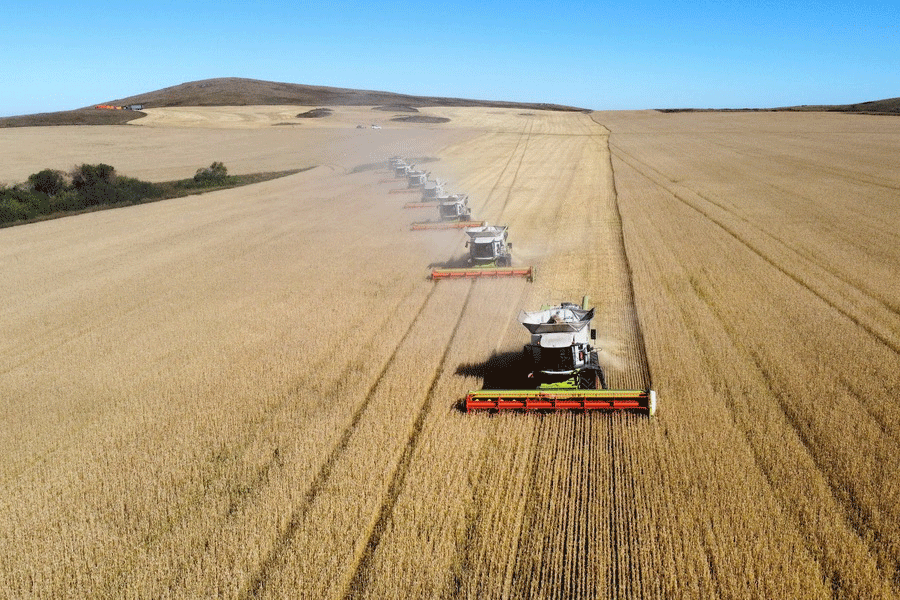
In Kazakhstan’s grain markets, a new equilibrium is being forged not just by supply and demand, but by the assertive presence of a state buyer. The recent announcement of forward purchase prices by the state-owned Prodcorporation has effectively set a price floor, causing farmers to resist selling their wheat for less. This has stabilized the domestic market, even in the face of two significant headwinds for exporters: a weakening US Dollar against the Tenge and sharply rising logistics costs. The result is a fractured market where price movements are heavily dependent on protein quality and end destination, illustrating the powerful influence of policy and infrastructure on agricultural profitability.
A Tale of Two Markets: Domestic Resilience vs. Export Pressures
The data from the Grain Union of Kazakhstan reveals a clear stratification. Domestically, the highest-quality wheat (Class 3 with 30+ gluten) saw the strongest gain, adding 2,000 Tenge/ton to reach 135-138,000 Tenge/ton. This reflects strong demand for premium grain, likely linked to the state’s procurement standards for its export programs. In contrast, lower-grade wheat and feed barley experienced minor price declines due to weak demand from key export partners like Iran and China. This weakness is exacerbated by a critical logistical bottleneck: a shortage of vessels on the Caspian Sea has led to a massive accumulation of railcars at the port of Aktau, causing delays and additional costs imposed by the national railway, KTZh.
Despite these domestic soft spots, export prices (on a DAP Saryagash basis) rose across all wheat classes. The increases ranged from $2/ton for lower-grade Class 3 wheat to a significant $7/ton for Class 5 wheat. This paradox—rising export prices amidst logistical chaos—is explained by two factors. First, the “substantial rise in logistics costs” is being baked into the price. Second, there is strong demand for lower-class wheat, which trades at a significant spread to premium grades, making it attractive for specific export contracts. Prodcorporation’s own aggressive shipping schedule, particularly to Algeria via the Georgian port of Poti, is consuming vast logistical capacity, creating a shortage of railcars and driving up comprehensive freight rates for all market participants.
The current situation in Kazakhstan provides a masterclass in how agricultural markets function when a state actor becomes a major player. The Prodcorporation’s price floor has empowered farmers, ensuring they are not forced into fire sales despite exporter pressures. However, this has not eliminated market risks; it has simply transferred and reshaped them. The real pressure point has shifted to the logistics chain, where bottlenecks and soaring costs threaten to erode the profitability of export sales. For farmers, the lesson is to understand the value of quality and the strategic importance of the state buyer. For agronomists and farm owners, it underscores that success in modern agriculture requires not just a good harvest, but a sophisticated understanding of geopolitics, logistics, and domestic agricultural policy. The ability to navigate this complex web of factors will separate the profitable operations from the rest.
Error