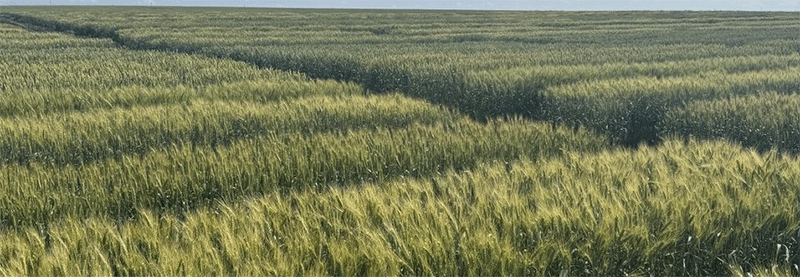
In the face of increasing climate volatility and biotic pressures, Russia’s agricultural sector is turning to advanced breeding programs to maintain its position as a global wheat powerhouse. EkoNiva Group has emerged as a key player in this effort, implementing a sophisticated soft winter wheat breeding program focused on developing varieties with high yield potential, superior grain quality, and crucially, resilience to environmental stresses. The company’s approach integrates modern laboratory techniques, including DNA analysis and phenotyping, with extensive field trials across diverse ecological zones. This scientific foundation is supported by specialized equipment, such as Zürn plot combines and precision Russian-made seeders, enabling efficient small-plot management and seed multiplication. The program’s success is demonstrated by its geographical reach, with EkoNiva varieties now cultivated in over 45 Russian regions and several neighboring countries, providing farmers with location-specific solutions that maintain productivity under challenging conditions.
EkoNiva’s breeding achievements are embodied in several notable varieties, each targeting specific agricultural challenges. The EN Taigeta cultivar (registered 2021) offers broad adaptation to different agricultural backgrounds and demonstrates exceptional resistance to ice crust formation, a critical trait for winter survival in continental climates. EN Foton (2022) provides robust resistance to common fungal diseases while maintaining high baking quality under stress. More recent introductions like EN Voin (2023) exhibit high drought resistance and protection against smut diseases, while EN Persei (2023) is distinguished by its ability to produce large seeds and high kernel content per spike. The newest addition, EN Titan (2025), represents a significant leap forward with reported yield potential reaching 13 t/ha, resistance to major diseases like brown rust and root rot, and tolerance to both drought and waterlogging. This focus on stress resilience aligns with global agricultural priorities; the FAO’s 2023 report on crop prospects highlights the urgent need for climate-adapted varieties as temperature fluctuations and extreme weather events increasingly threaten cereal production worldwide.
EkoNiva’s systematic approach to winter wheat breeding represents a crucial adaptation strategy for Russian agriculture in an era of climate uncertainty. By developing varieties with enhanced tolerance to abiotic and biotic stresses while maintaining high yield potential and grain quality, the company is addressing fundamental challenges facing cereal producers. Their success demonstrates the importance of integrating modern biotechnology with practical agronomic testing to create solutions that ensure both farm-level profitability and national food security. As environmental pressures intensify, such targeted breeding programs will become increasingly essential for maintaining stable wheat production in Russia and other major grain-producing regions.
Error