

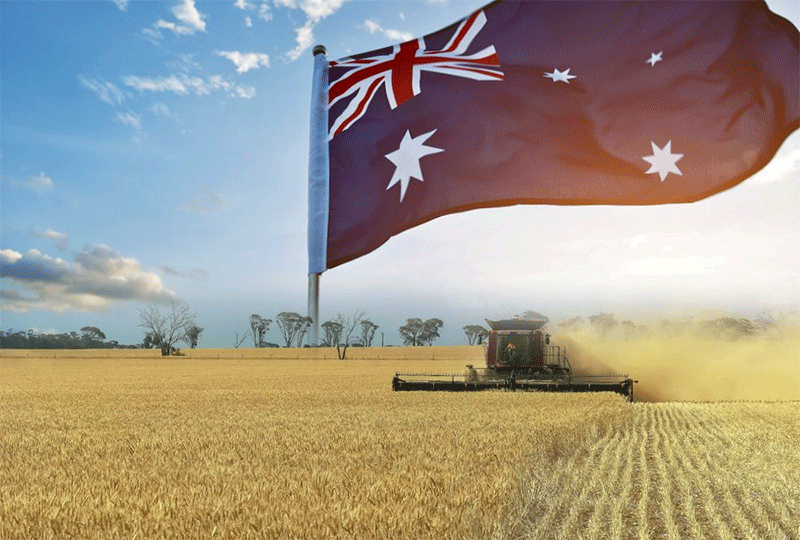
Just months after projections pointed to a historic bounty, Australia’s wheat harvest is under severe threat. A significant dry spell across the key southeastern states of Victoria and South Australia during the crucial month of September is now expected to substantially cut yields. This downturn comes after a wet winter had initially set the stage for the country’s fourth-largest wheat harvest on record, as forecast by the USDA in September. The Bureau of Meteorology reported that rainfall in September was “below average,” with South Australia receiving less than 10 mm—half its historical average for the month.
The impact is immediate and tangible. Analysts at Bendigo Bank report that soil moisture has deteriorated, and with rising temperatures, crop conditions are beginning to decline. These southeastern states, which account for roughly a quarter of Australia’s national harvest and were expected to produce around 8.2 million tonnes, are now at the heart of the production crisis.
Quantifying the Loss: A Global Ripple Effect
The financial and agricultural implications are being calculated in real-time. Bendigo Bank has warned that production estimate cuts are likely in the coming month. They project a potential reduction of between 500,000 and one million tonnes for Victoria and South Australia combined if conditions worsen. This is not merely a local issue. As one of the world’s top wheat exporters, a supply reduction from Australia has immediate consequences for the global market, tightening supplies and potentially elevating international prices.
The window for recovery is narrow. The Bureau of Meteorology forecasts only a minor chance of above-average rainfall for the remainder of 2025, with most potential rain not expected until November. The critical dilemma, as noted in the report, is that if this rain arrives “too late, it could delay harvesting,” potentially compromising grain quality even if it salvages some yield.
The Global Context: A Recurring Pattern of Climate Stress
The situation in Australia is a stark example of a global pattern where climate volatility is increasingly disrupting grain production in major exporting nations. According to the Food and Agriculture Organization’s (FAO) 2024 report on climate disasters, drought remains the single greatest threat to agricultural production, accounting for over 80% of total crop and livestock losses.
Furthermore, this event mirrors challenges seen in other hemispheres. The recent harvest difficulties in Kazakhstan due to early snow and the quality issues in Russia’s Oryol region, while different in their nature (excess moisture vs. drought), all point to the same underlying vulnerability: key grain-producing regions are operating under increasingly unstable climatic conditions. A study in Nature Food recently concluded that the probability of concurrent crop failures in multiple major breadbaskets, driven by climate extremes, has significantly increased, posing a systemic risk to global food security.
The Non-Negotiable Investment in Resilience
Australia’s deteriorating wheat harvest is more than a seasonal setback; it is a powerful case study in modern agricultural risk. It highlights the precarious gap between early-season potential and final harvested yield, a gap that is widening due to climate change.
For farmers, agronomists, and policymakers worldwide, the conclusions are clear:
- Climate Resilience is Economic Security: Investing in drought-tolerant crop varieties and water-efficient farming practices is no longer optional but essential for business continuity.
- Risk Management Must Be Proactive: Reliance on seasonal forecasts must be coupled with robust contingency plans for both drought and deluge.
- The Global Market is Interconnected: A drought in Australia reverberates through the global supply chain, affecting prices and food security thousands of miles away.
The fate of Australia’s wheat crop is a reminder that in today’s climate, a successful harvest is not just sown in the soil, but also secured through strategic planning for an increasingly unpredictable growing season.
Error