

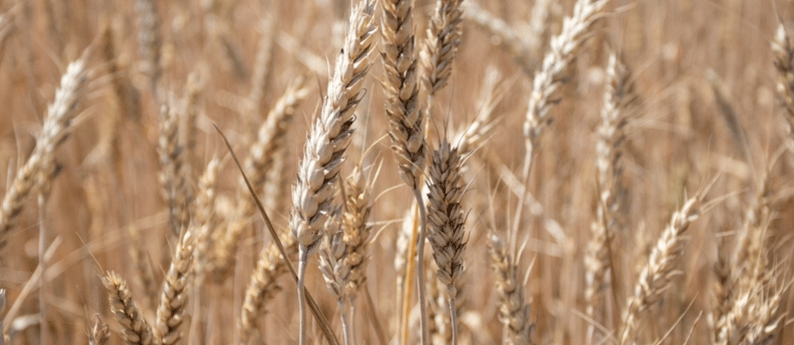
The Stavropol region, a powerhouse of Russian agriculture, has announced a historic achievement for the 2025 season: a grain harvest exceeding 10 million tonnes from an area of 2.2 million hectares. This record-breaking yield was underpinned by a equally significant strategic accomplishment: 100% of the wheat sown in the region was of domestic breeding. This figure highlights a concerted and successful effort to achieve self-sufficiency in the most critical crop for the region’s economy and the nation’s food security.
The success was not limited to wheat. The region’s Minister of Agriculture, Sergey Izmalkov, provided a detailed breakdown of seed self-sufficiency across other major crops, showcasing a varied but proactive landscape:
- Sunflower: 50%
- Soybean: 54%
- Corn: 25%
- Sugar Beet: 9%
- Potato: 14%
This data reveals a strategic prioritization, with full self-sufficiency achieved in the staple grain, while work continues on high-value oilseeds and more complex hybrid crops.
The Engine of Growth: State Support and Strategic Investment
This shift towards domestic seed sovereignty did not happen in a vacuum. It has been actively driven by state policy and substantial financial backing. The regional government supports farmers through 40 different support directions, with a total allocation of 6.7 billion rubles, 65% of which has already been disbursed to farmers.
Furthermore, to facilitate investment and operational liquidity, agricultural producers have received soft loans totaling 19.9 billion rubles. This financial ecosystem reduces the risk for farmers to invest in domestic genetics and modern technologies. An additional innovative measure was the implementation of a cloud-seeding program to artificially increase precipitation, funded with 38 million rubles, demonstrating a holistic approach to mitigating climate volatility and supporting yield potential.
The Global Context: Seed Sovereignty as a Strategic Imperative
Stavropol’s focus on domestic seed development aligns with a growing global trend where nations are re-evaluating their dependence on imported agricultural inputs. According to a 2024 report by the UN’s Food and Agriculture Organization (FAO), strengthening local seed systems is crucial for building resilient food systems, especially in the face of global trade disruptions and climate change.
Research from the International Food Policy Research Institute (IFPRI) also indicates that locally-adapted crop varieties can often demonstrate superior performance in their specific agro-ecological zones compared to generic international hybrids, particularly under environmental stress. Stavropol’s record wheat harvest, achieved entirely with domestic seeds, serves as a powerful case study for this principle.
A Model of Integrated Agricultural Policy
The Stavropol success story offers a clear blueprint for other regions aiming to boost productivity and sovereignty. It demonstrates that record harvests are the result of an integrated strategy, not a single-factor solution. The key pillars of this model are:
- Prioritizing Strategic Self-Sufficiency: Focusing first on achieving seed independence in staple crops that form the backbone of the food system.
- Creating an Enabling Financial Environment: Providing direct subsidies and soft loans to de-risk adoption and encourage investment.
- Leveraging Technology Holistically: Combining agronomic advances with supportive infrastructure, even extending to weather modification, to create optimal growing conditions.
For farmers and farm owners, the message is that domestic seeds, when supported by strong R&D and precise agronomy, can deliver top-tier yields. For scientists and engineers, it validates the critical importance of developing locally-adapted genetics. Stavropol proves that agricultural prosperity is cultivated not just in the fields, but also in the policy and research institutions that support them.
Error



