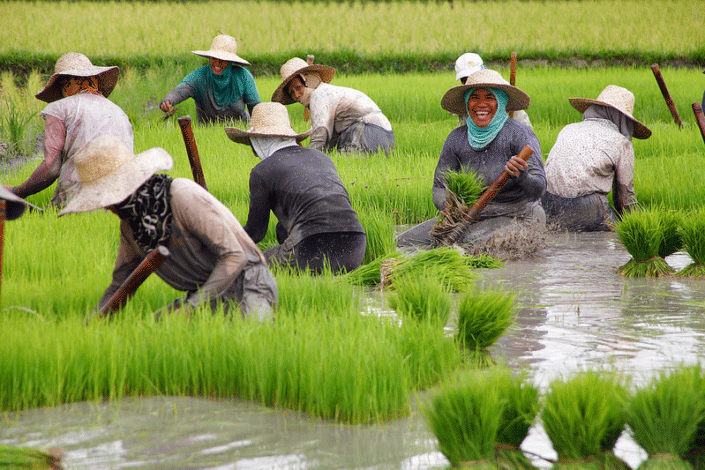
For millions in the Philippines, a plate of white rice is the foundation of daily sustenance. Yet, this very staple, while filling, often lacks essential micronutrients, contributing to a pervasive public health issue known as “hidden hunger.” Vitamin A Deficiency (VAD) remains a critical problem, leading to blindness, impaired immune function, and stunted growth in children. In a groundbreaking response, a coalition of research institutions and government bodies is turning to biofortification, engineering the rice itself to become a vehicle for nutrition. The flagship of this effort is ‘Golden Rice,’ a variety genetically enriched to produce beta-carotene, a precursor to Vitamin A.
A Decade-Long Collaboration for Nutritional Security
The development and deployment of Golden Rice is a testament to sustained international partnership. Led by the Philippine Rice Research Institute (PhilRice) and the International Rice Research Institute (IRRI), with support from global biofortification leader HarvestPlus (part of the CGIAR system), the project has spanned over a decade. The goal was not only to engineer the nutritional trait but also to ensure the agronomic performance of the rice met the needs of local farmers. Initial plantings began in 2022, strategically targeting provinces with the highest recorded levels of VAD. PhilRice has been instrumental in distributing seeds to local farmers and providing tailored agronomic training, while IRRI has collaborated with government agencies to monitor both yield and nutritional consistency.
The Nutritional Impact and Integration Strategy
The potential health impact is significant. Research indicates that just one cup of cooked Golden Rice can provide 30–50% of a child’s estimated average requirement (EAR) for Vitamin A. For low-income families who cannot regularly afford diverse foods like vegetables, meat, or dairy, this represents a low-cost, sustainable strategy to improve dietary quality.
The Philippine Department of Agriculture is committed to scaling up production, with plans to integrate Golden Rice into national programs, including school feeding schemes and local market systems. This approach ensures the biofortified crop reaches those who need it most, directly through the existing food distribution channels they rely on.
A Model for the Future of Food Systems
Golden Rice is part of a broader, crucial shift in agricultural development, where the focus expands beyond caloric yield to nutritional density. It serves as a model for a new generation of biofortified crops. Alongside Vitamin A-enriched rice, IRRI and HarvestPlus are also advancing varieties high in zinc and promoting iron-rich staples like beans and pearl millet across the region. These innovations are designed to address multiple micronutrient deficiencies simultaneously, without requiring significant changes in consumer behavior. They represent a powerful convergence of agricultural science and public health policy.
The story of Golden Rice in the Philippines is more than a narrative of genetic engineering; it is a case study in how to tackle systemic public health challenges through agricultural innovation. By embedding essential nutrients directly into the most widely consumed staple food, scientists and policymakers are creating a highly efficient and culturally acceptable intervention. For farmers, it offers a crop that contributes directly to community health; for agronomists and engineers, it presents the challenge and opportunity of integrating new varieties into diverse growing systems. While debates around such technologies continue, the targeted, evidence-based deployment of biofortified crops like Golden Rice offers a pragmatic and promising tool in the global fight against hidden hunger, turning the humble paddy field into a frontline for public health.
Error