

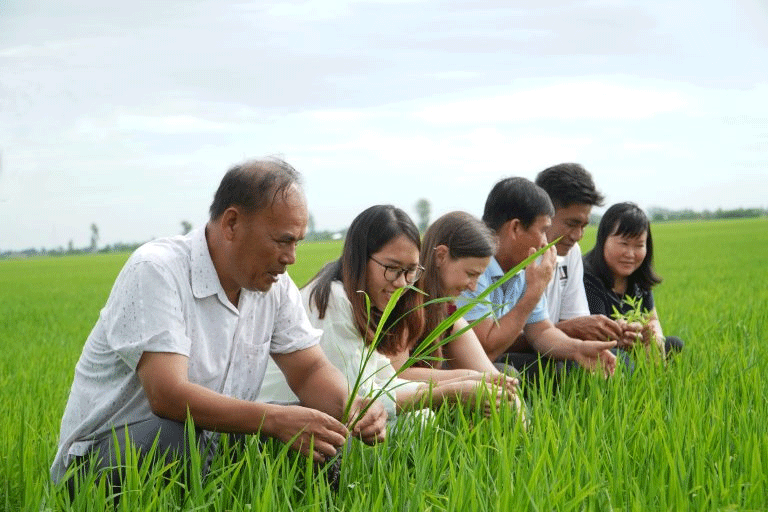
For generations, rice improvement focused on the plant itself—yield, disease resistance, and grain quality. Today, a new revolution is underway, targeting not the plant, but the entire system in which it is grown. The challenge is no longer just proving that low-emission, sustainable practices work; it’s creating the enabling environment that makes them accessible and profitable for millions of farmers. Leading this systemic change are strategic public-private partnerships (PPPs), which are leveraging scientific expertise to build the financial, policy, and market infrastructure required for a global shift.
The Blueprint for Change: Three Models of Collaborative Impact
The International Rice Research Institute (IRRI) is at the heart of this transformation, acting as a trusted scientific partner in several groundbreaking collaborations. These partnerships demonstrate a multi-pronged approach to driving adoption at scale.
- National Transformation: The Partnership for Sustainable Agriculture in Vietnam (PSAV)
In Vietnam, a nation central to global rice exports, the PSAV operates as the technical arm of the ambitious One Million Hectare Program for low-emission rice. Here, IRRI’s role is not confined to a research station. Scientists provide direct technical guidance to the government and industry on critical issues like technology adoption, certification protocols, and market linkages. This ensures that a national strategy, capable of impacting vast landscapes, is built on a foundation of robust, independent science from the very beginning. - Unlocking Global Finance: The Sustainable Rice Landscapes Initiative (SRLI)
Scaling sustainable practices requires massive capital. The SRLI, a global coalition, addresses this by developing innovative financial mechanisms. A key project is its Blended Finance Facility, which uses public or philanthropic grant money to de-risk investments for private capital. This model is proving the concept and paving the way for a targeted global rice fund anticipated to exceed USD $500 million. IRRI’s scientific leadership within SRLI ensures these financial instruments are tied to verifiable environmental outcomes, such as methane reduction, giving investors confidence that their capital is generating real impact. - Creating Market Pull: The First Movers Coalition for Food (FMC4F)
Ultimately, sustainability must be driven by demand. The FMC4F, an industry-led group of major food corporations, creates a powerful “market pull” by making advance purchase commitments for sustainably grown rice. IRRI’s critical function is to provide the scientific integrity behind these commitments. The institute develops the high-integrity standards and Measurement, Reporting, and Verification (MRV) tools that credibly define what “sustainable” and “low-emission” mean. This bridges the gap between corporate pledges and on-farm reality, ensuring that procurement drives genuine practice change.
The Catalytic Value of Science in Partnership
The work of these partnerships represents a fundamental evolution in agricultural development. The most significant impact is often catalytic—shaping policy, de-risking finance, and validating markets—rather than being measured in traditional academic outputs. For farmers and agronomists, this means a future where adopting climate-smart practices is increasingly supported by clear economic incentives and reliable market access. For agricultural engineers and scientists, it presents a challenge and an opportunity to develop solutions that are not only effective but also readily integrable into these new systems. The success of this collaborative model suggests that the future of sustainable agriculture will be built not by any single breakthrough, but by interconnected ecosystems of innovation where science, policy, and finance converge to support the farmer.
Error


