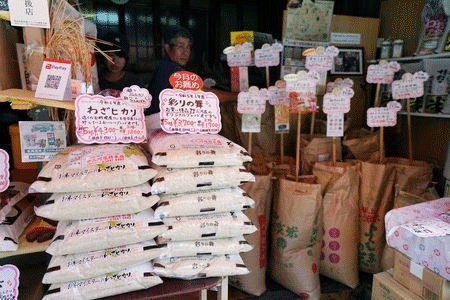
After a prolonged period of record-breaking inflation, Japan’s rice market is showing tentative signs of cooling. Data from the Ministry of Agriculture for the week ending Sunday revealed a second consecutive weekly price drop, with the average price at approximately 1,000 supermarkets falling by 35 yen to 4,211 yen per 5 kilograms. While this marks a welcome shift, the price remains above the psychologically significant 4,000-yen threshold for the fourth week in a row, leaving market observers to question the durability of this trend.
The Data: A Broad-Based but Modest Decline
The ministry’s report indicates a broad-based, though not uniform, price decrease across different retail channels. A separate survey of about 1,200 supermarkets showed a steeper decline of 51 yen to 3,539 yen per 5kg, while a survey of 6,000 drugstores and other shops recorded a 57-yen drop to 3,995 yen. This widespread softening suggests a systemic influence on the market rather than isolated discounting.
Drivers of the Decline: Policy and Prognostication
Two key factors are credited for this recent price moderation:
- Strategic Government Stockpile Release: The primary immediate driver is the government’s decision to extend the sales period for rice released from its public stockpiles. By continuing to inject this “relatively cheap” rice into the supply chain beyond the original August deadline, the government has directly increased available inventory, applying downward pressure on prices. This action demonstrates a continued reliance on direct market intervention to manage stability.
- Optimistic Harvest Forecasts: Adding to the bearish sentiment are positive projections for the 2024 harvest. Agriculture Minister Shinjiro Koizumi announced that this year’s rice production is expected to grow by 560,000 tons from the previous year. He further noted that industry executives predict an even larger increase. This anticipated rebound from the previous year’s poor harvest is a powerful signal to the market that the supply crunch may be easing.
Global Context and Structural Challenges
This situation in Japan offers a contrasting narrative to other global rice markets. While many major exporting nations have faced inflationary pressures due to climate events and export restrictions, Japan’s heavily managed domestic system is demonstrating its ability to force a price correction—at least in the short term. However, this system is not without its costs and critics. As highlighted in recent political upheavals, the model has been criticized for its rigidity and failure to prevent the initial price spike.
The long-term challenge, as voiced by farmers like Nobuo Kubo from Hokkaido, is whether policy can evolve from temporary fixes—like stockpile releases—to a sustainable vision that provides farmers with a clear and profitable future, ensuring the nation’s food security.
The recent dip in Japan’s rice prices is a direct result of calculated government intervention and growing confidence in the upcoming harvest. While this provides much-needed short-term relief for consumers, it does not necessarily indicate a resolution of the sector’s underlying structural issues. The effectiveness of the government’s longer-term strategy—shifting from production control to encouraging larger harvests for both domestic use and a strategic export buffer—remains to be tested. For farmers, agronomists, and policymakers, the coming months will be critical. They will reveal whether this price decline is the beginning of a new equilibrium or merely a pause in a volatile cycle, and whether the reforms can successfully balance consumer affordability with the economic viability of domestic rice farming.
Error