From Seed to Satellite: How Bachu County is Mastering the Science of Winter Wheat
As the autumn season sets in, Bachu County is transforming its agricultural landscape into a hive of meticulously planned activity. The annual winter wheat sowing campaign is underway, representing a critical investment in the region’s food security and economic stability. This is not the traditional sowing of the past; it is a highly coordinated operation where advanced machinery, scientific principles, and strategic policy support converge to optimize every step of the process.
Precision in Motion: The Machinery of Efficiency
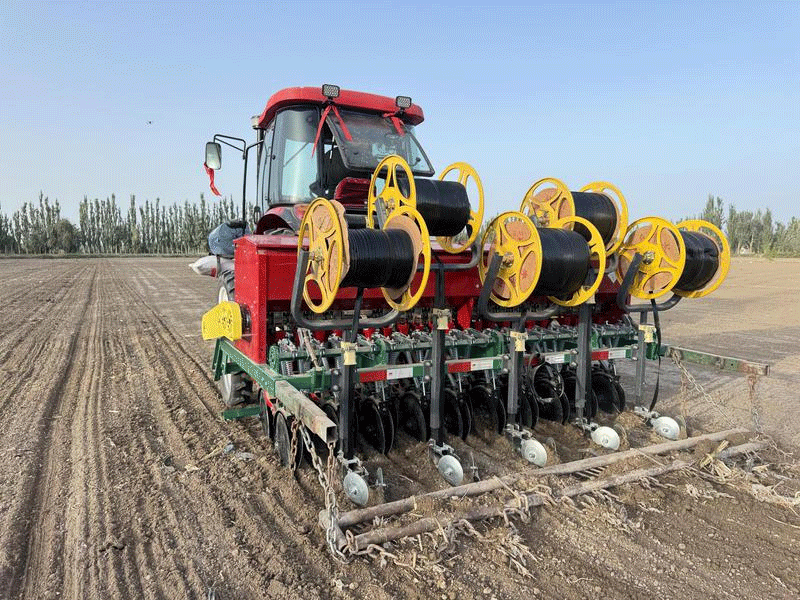
At the heart of this transformation is the widespread adoption of sophisticated agricultural machinery. In the high-standard farmland of towns like Awati, large seeders are seamlessly performing combined operations. As described by planting machine operator Abduxukre Ali, modern equipment that integrates seeding and fertilizing is now standard. “The biggest advantage is the integration of fertilizer and seeds, and you can clearly see the sowing situation,” he noted.
The true game-changer, however, is the integration of guidance technology. These seeders, paired with the most advanced tractor navigation systems, are achieving remarkable efficiency. A single machine can cover between 120 and 130 mu (approximately 8 to 8.7 hectares) per day. This speed and precision are fundamental to meeting the county’s tight sowing deadline, with all 265,000 hectares slated for completion by October 15th. This push is supported by a fleet of over 40 coordinated machines in Awati Town alone, contributing to a district-wide mechanization rate of 100% for this critical operation.
The Science Behind the Yield: Data-Driven Agronomy
The technological advancement extends beyond the machinery itself into the very methodology of crop management. Farmers are moving away from broad-stroke approaches to highly targeted, science-led practices. The widespread use of techniques like dry sowing with wet emergence and drip irrigation with integrated water-fertilizer management is a testament to this shift. These methods are renowned for conserving water—a precious resource—and enhancing nutrient use efficiency, leading to stronger, more uniform plant establishment.
This focus on science is yielding tangible results. Farmer Usman Abula, who enjoyed a profitable harvest last year, is confident for the season ahead. “We believe we can harvest about 600 kilograms of winter wheat per mu this year,” he stated. This target aligns with national efforts to boost yields; for context, China’s average wheat yield has been steadily increasing, reaching over 5,800 kg/hectare (approximately 387 kg/mu) in recent years, making Bachu’s goal of 600 kg/mu (9,000 kg/hectare) an ambitious benchmark that reflects the success of its intensive model.
A System of Support: Policy and Guidance
This agricultural transformation is not happening in a vacuum. It is underpinned by a robust support system that includes technical guidance and financial incentives. Agronomists and government cadres, like Guli Zaibai·Nayifu from the Awati Town Agricultural Development Center, are providing continuous, in-field technical support throughout the sowing period. This ensures that the theoretical benefits of new technologies are fully realized in practice.
Furthermore, national subsidy policies for wheat cultivation provide a crucial financial safety net, encouraging farmer participation and investment in quality inputs. This combination of on-the-ground expertise and economic support creates a powerful enabling environment for adoption and success.
The winter wheat sowing campaign in Bachu County is a compelling case study in modern, productive agriculture. It demonstrates that achieving high yields is an integrated process where advanced mechanization, precision agronomy, and supportive policy are inextricably linked. The successful implementation of 100% mechanized sowing, water-saving techniques, and data-guided management provides a scalable model for other regions. For farmers and agronomists globally, Bachu’s approach underscores that the future of cereal production lies in the intelligent integration of technology and science to consistently deliver quality, yield, and efficiency from the very first seed.
Error