

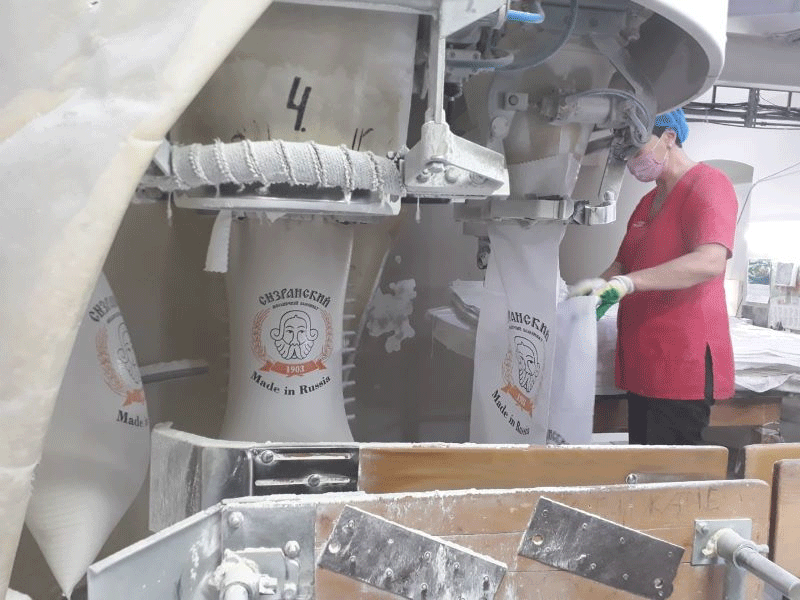
The Syzran Museum of Local Lore is preparing an exhibition aptly titled “Grain,” dedicated to the city’s historic steam-powered roller mills. At the turn of the 20th century, these mills propelled Syzran into an elite group of Russian cities leading in grain processing and sales, ranking alongside the major provincial hubs of Nizhny Novgorod, Samara, and Saratov. This historical prominence underscores a period where localized milling infrastructure was a critical determinant of regional agricultural economic power.
To bring this history to life, museum curators went beyond their own archives to visit the physical sites of this industrial heritage. They conducted field research at two landmark locations: the former mill of K.A. Ilyin, now the Syzran Mill Complex, which continues to operate with modern equipment, and the former mill of A.A. Sterlyadkin, now the Syzran Bread Products Complex, where the original, non-operational machinery has been preserved. This preserved equipment stands as a testament to the sophisticated, albeit now obsolete, technological processes of early roller milling.
The historical significance of Syzran’s milling industry aligns with a major technological shift in global agriculture: the transition from stone grinding to roller milling. According to historical industrial data, the adoption of roller mills in the late 19th and early 20th centuries dramatically increased flour extraction rates and improved quality, fueling the growth of centralized milling hubs exactly like those in Syzran. This revolution was as impactful in its time as the move toward automation and digitalization is in modern grain processing today.
The “Grain” exhibition is more than a historical retrospective; it is a reminder of the foundational role that processing technology plays in capturing the full value of agricultural production. Syzran’s past as a milling leader illustrates how innovation in post-harvest handling can define a region’s economic standing. For today’s farmers, agronomists, and engineers, it reinforces the continuous thread connecting field production to industrial processing, reminding us that the quest for efficiency, quality, and value addition in the grain supply chain has been a driving force in agriculture for over a century.
Error


