

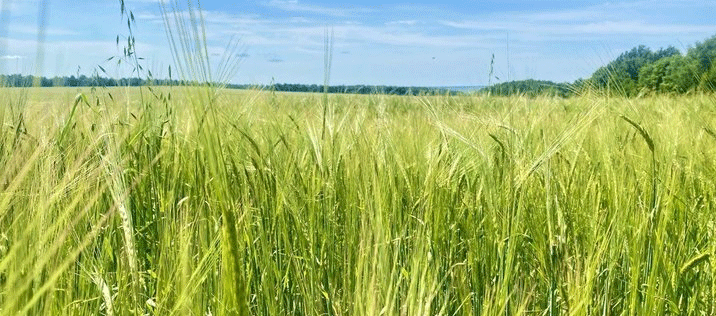
A significant food safety breach has been identified in Tatarstan, raising concerns for grain producers and buyers alike. Specialists from the laboratory of the Federal State Budgetary Institution “Center for Quality Assurance in Agro-Industrial Complex” (FGBU “TsOK APK”) detected excessive levels of the insecticide Lambda-cyhalothrin in batches of wheat and barley from the Alexeyevsky district. The total volume of the affected lots was 5,000 tons, highlighting the potential scale of such incidents.
The laboratory analysis revealed alarming concentrations. In a sample of feed wheat, the residual level of Lambda-cyhalothrin was 0.064 mg/kg, a staggering 6.4 times above the maximum permitted level of 0.01 mg/kg. Similarly, a sample of feed barley showed a concentration of 0.038 mg/kg, exceeding the norm by 3.8 times. Lambda-cyhalothrin is a potent pyrethroid insecticide effective against a range of pests, but its misuse poses risks to environmental and human health. The information has been forwarded to the Rosselkhoznadzor (Russian Federal Service for Veterinary and Phytosanitary Surveillance) for further action.
This incident, while serious, must be viewed in a broader context. Since the beginning of January 2025, the same laboratory has conducted over 22,000 tests on 8,800 samples of grain and its processed products for pesticide residues. Of these, non-compliance was detected in only 80 samples, representing a 0.9% failure rate. This suggests that the vast majority of Russian grain production adheres to safety protocols. However, the Tatarstan case demonstrates that even a small percentage of non-compliance can lead to large, problematic batches. This aligns with global food safety data; the European Union’s Rapid Alert System for Food and Feed (RASFF) for 2023 reported that pesticide residues remain a leading cause of border rejections for agricultural imports, emphasizing the critical need for rigorous control throughout the supply chain.
The article also touches on a related challenge: declining farm profitability. Deputies of the State Duma have expressed concern over falling purchases of agricultural machinery, linking it to decreasing income in the agrarian sector. This financial pressure can create a perverse incentive to cut corners, whether on the precise application of pesticides or investment in modern, precision equipment that ensures correct application.
The pesticide超标 in Tatarstan is a multi-faceted warning. For farmers and agronomists, it reinforces the non-negotiable importance of strictly following application rates, pre-harvest intervals, and integrated pest management (IPM) strategies. For the industry and regulators, it underscores the value of robust monitoring systems that can identify problems before contaminated grain enters the wider market. Finally, it highlights the interconnectedness of economic health and food safety. Policies that support farm profitability are essential to enabling producers to invest in the technologies and practices that ensure both high yields and safe, compliant products.
Error