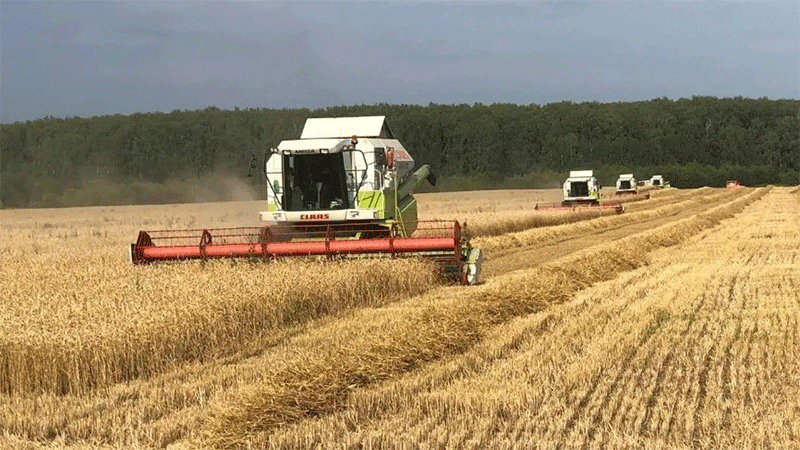
In a demonstration of the power of modern plant breeding, the agricultural enterprise “Pyshlitskoye Agro” in the Shatura district of the Moscow Region has harvested a record yield of winter wheat. The farm achieved an impressive 70 centners per hectare (approximately 7 metric tons/ha) using the new variety “Ermolovka.” This result more than doubles the average winter wheat yield for the Moscow Region, which typically ranges between 30-40 centners per hectare (3-4 t/ha).
The “Ermolovka” variety, a soft winter wheat intended for food production, was developed by JSC “Shchelkovo Agrokhim.” The company, which has been advancing domestic breeding and seed production for over 25 years, holds a portfolio of more than 120 patents. This achievement is a testament to targeted genetic improvement. According to the UN’s Food and Agriculture Organization (FAO), increasing crop yields through genetic gains is a cornerstone of sustainable intensification, crucial for meeting global food demand without expanding agricultural land. The success in the Moscow Region, which is not part of Russia’s primary black soil belt, proves the potential of tailored genetics to maximize productivity in diverse and sometimes challenging growing conditions.
Beyond wheat, “Shchelkovo Agrokhim” is applying this strategy to other key crops. The company has recently presented new high-yielding winter rapeseed varieties, Loris and Elvis, developed in collaboration with the V.S. Pustovoit All-Russian Research Institute of Oil Crops (VNIIMK). These varieties, alongside the champion spring rapeseed variety Forpost KL, are designed for multi-purpose use: oil and meal production, green mass for feed, and as a cover crop. This aligns with a global trend towards multi-functional cropping systems that enhance farm profitability and sustainability. Data from the International Seed Federation (ISF) consistently shows that investment in plant breeding delivers an annual yield increase of around 1-2%, making it one of the most effective tools for farmers to improve their bottom line and resilience.
The record harvest in the Moscow Region is more than a local success; it is a powerful case study for the entire agricultural sector. It underscores that future productivity gains will be increasingly driven by genetic innovation rather than just expansion of inputs. For farmers and farm owners, this emphasizes the importance of selecting modern, well-adapted varieties. For agronomists and engineers, it highlights the need to integrate these advanced genetics with precision management practices. For scientists and policymakers, it reinforces the critical need for sustained investment in domestic breeding programs to ensure agricultural sovereignty and competitiveness in a changing climate.
Error