In preparation for the upcoming winter sowing season, Dagestan’s agricultural sector is taking a significant step away from genetic uniformity. As reported by the Rosselkhozcenter of Dagestan, farmers in regions like the Buynaksky district are actively planning to expand the number of winter wheat varieties used in their fields. This move signals a growing recognition among agronomists and farm owners that resilience is the cornerstone of modern, sustainable agriculture.
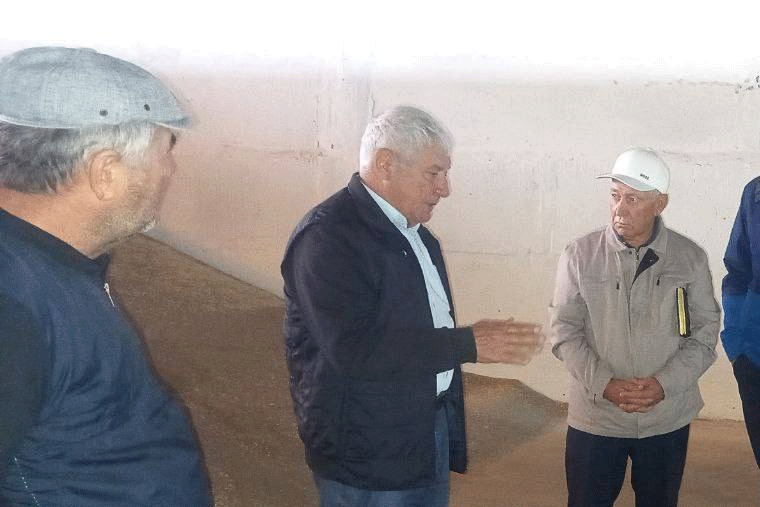
To secure high-quality genetic material, a delegation recently visited the “Otbor” seed selection center in the Kabardino-Balkarian Republic. This center specializes in cultivating seeds of promising varieties of winter wheat, corn, and peas. The visit was not merely a procurement trip but a strategic mission to access elite genetics tailored to the challenging conditions of the North Caucasus.
The interest in diversifying wheat varieties is well-founded by agronomic science and current data. Monocultures, while logistically simple, are highly vulnerable to biotic and abiotic stresses. According to a 2023 report by the UN’s Food and Agriculture Organization (FAO), cultivating a range of crop varieties is a key risk-management strategy, potentially reducing yield losses from disease outbreaks or extreme weather events by up to 20-30%. For winter wheat specifically, the choice of variety is paramount. Data from the Russian Research Institute of Phytopathology indicates that using resistant or tolerant varieties can decrease pesticide use by 15-25%, directly impacting farm economics and environmental footprint.
The “Otbor” center likely offers varieties with diverse genetic traits—some with superior drought tolerance, others with enhanced resistance to local strains of rust or powdery mildew, and others still with improved baking quality. This allows Dagestani farmers to engage in precision agriculture at the most fundamental level: matching specific varieties to specific field conditions. A 2022 study published in the Journal of Agronomy and Crop Science demonstrated that a multi-cultivar approach in wheat systems can stabilize yields year-over-year, smoothing out the volatility caused by increasingly unpredictable climates.
The preliminary supply agreement reached following the visit is a concrete step towards implementing this strategy. By integrating these new varieties into their sowing plans, Dagestani agricultural engineers can create a more robust production system. This is not just about increasing the number of varieties, but about strategically deploying them to enhance overall system health.
Dagestan’s initiative to diversify its winter wheat varieties is a forward-thinking strategy that aligns with global best practices in agricultural science. It moves beyond a focus solely on yield potential towards a more holistic view of farm resilience. By leveraging specialized breeding centers and adopting a multi-cultivar framework, farmers and agronomists in the region are building a defense against climate volatility and pests, ultimately working towards more stable and sustainable production outcomes. This proactive approach serves as a valuable model for other agricultural regions facing similar challenges.
Error